Tuesday, 6 June 2017

How You Can Use Social Learning To Engage Your Learners

Although the social learning phenomenon is catching up, many in the learning sphere are not sure of its impact owing to misconceptions around it and lack of data to showcase its impact. This article outlines how you can use social learning effectively to engage your learners.


How Can You Use Social Learning To Engage Learners?


In simple terms, social learning is learning with and from others and is not bound by a specific type of learning. Social learning could be anything – acquiring knowledge about something when discussing casually with your friends or colleagues, during a conversation with a co-passenger on a flight, or even learning when browsing and interacting with folks on social media sites such as Facebook, Twitter, LinkedIn, and so on. So, how can you use social learning?

This kind of learning -triggered by collaboration- is never short of positive impact. The social media phenomenon has revolutionized the way people perceive things and go about their everyday lives. The impact has spilled over to pretty much everything and if it is not leveraged upon for learning, Learning and Development professionals have only themselves to blame.


What Are The Misconceptions Surrounding Social Learning?


There are several misconceptions surrounding social learning and I pick a few of them:


1. A new concept – not tried and tested.


While the buzz on adoption of social learning by organizations is new, the social learning concept has been there for over five decades now. The current dynamics (advent of social media channels, technology, and changing learner profiles) have accelerated its adoption by organizations now.


2. It appeals only to Millennials.

While it certainly appeals to Millennials, social learning is as relevant to all other learner profiles as well.


3. Works on social media channels but cannot be used to provide serious learning.

While social media channels can certainly be used for social learning, there is a need to have custom platforms supported by a clear learning strategy if you want to meet specific learning outcomes.


4. It is fun and not structured so it just cannot create the required impact.

Social learning provides Learning and Development teams with another channel to offer learning. However, the desired impact is in direct proportion to the learning strategy you put in place.


Why Does Social Learning Work And Why Does It Make Sense To Adopt It?

Social learning as such is not a new concept. It has been part of our learning mechanism all through and there are several theories to support this claim. The 70/20/10 Model for Learning and Development, social learning theory, and Active Learning theory in particular make a great case for social learning.

You can refer to my article Why You Should Adopt Social Learning to know more about how these theories establish the need to integrate social learning components in corporate training and how social learning can benefit learners and organizations alike.

But if this doesn’t sound convincing enough to consider social learning as part of your learning strategy, you’d want to take a look at these facts and stats:


  • Social learning approaches have a 75:1 ROI ratio over web-based training (Association for Talent Development).
  • 82% of businesses that use Social technology want to use them in the future (Accenture).
  • The course completion rates shot up to 85% on HBX, a Harvard Business School online education initiative with the introduction of social learning, way better than online-only MOOCs (Harvard Business Review).
  • Cisco’s use of social learning to support its transition to a global services organization saw a 98% employee adoption rate in the first year with 80% of learning content socially generated (ChiefLearningOfficer).
  • According to a Stanford research, 45% of their physicians benefited from social learning in a medical photo-sharing app for doctors as a patient care related study aid (Stanford Medicine).
  • 73% of the surveyed companies expected to increase their focus on social learning and more than 60% wanted their employees to interact with learning resources on a daily basis (Brandon Hall Group).
  • AMD, a semiconductor manufacturing company, says their shift to social learning strategy saves more than USD 250,000 per year in web based training production costs (Kenexa).
  • Villeroy & Boch, a large manufacturer of ceramics, deployed a social learning framework for their training courses resulting in a 32% increase on Average Transaction Value with +19% sales in Japan (Curatr).

How Can You Use Social Learning?

You can look at social learning through a larger prism – that of a “Learning and Performance Ecosystem“. You can bring in a combination of various kinds of learning, blending formal and informal learning, and supplement your learning with social learning and Performance Support elements. This will provide your learners with more options and ways to learn and experience “learning as a continuum”.


Performance Support Tools


Learners like learning in different ways. Their preferences differ from one another. Providing them with a platform such as this with multiple options to learn will increase the likelihood of the learning appealing to the learning style of different learners. Besides, this approach will help you not just achieve the required levels of acquisition and application of knowledge on the job but a positive return on investment on your training.


Case Study – Our Internal Social Learning Portal

At EI Design, we offer customized social learning platforms for our customers. I share a case study that shows how we have adopted social learning to promote several initiatives.

As an example, I showcase how the platform helped our employees learn about the processes that we need to follow in our organization.


The Objective

We built this platform to foster a collaborative work environment, fuel interactions between team members, create communities of learning and practice, and provide a medium to our employees to receive on-the-job support.

The Impact

The platform has enabled our employees to:

  • Feel free to seek help from their peers, anytime they want.
  • Receive on-the-job support.
  • Collaborate with members of other teams.
  • Learn about our processes and other organization-related learning topics in a simplified, informal way.
  • Be more aware of what’s happening in the organization and what members of other teams have been doing.
  • Foster a collaborative work culture with a personalized touch.
  • Enrich their knowledge and learn new skills to help them in their job.


The Features

1. An element of personalization.


Employees can upload their photo, customize their account, provide a description about themselves, and make personal details (such as their birthday, address, Facebook URL, Twitter URL, etc) known to others.

2. The concept of “Spaces”.

  1. Users can create Spaces, which are used for focused discussions that can be moderated to meet specific outcomes.
  2. For example, we have a space called Process, where employees can share their views about the process steps, ask questions or seek clarifications with regard to clarity on any of the process steps, and so on. This helps our employees collaborate to get on-the-job support thereby bringing in greater efficiency and reducing time.
  3. The owner of the space can invite other users and make it public.
  4. Under each space, we can have additional channels to learn and share, such as: 
  • Wikis.
  • Tasks.
  • Polls.
  • Files.
3. Employees can share videos, pictures, their thoughts, or web content on their timeline (similar to Facebook).

Furthermore, they can:

  • Comment.
  • Like.
  • Follow (User to User, User to Space, User to Content).
  • Mention other users.
  • Tag other users.
  • Make use of the Embed Support (share YouTube and other web links which will be easily embedded in the platform).


4. Collaboration and engagement.
  • Each asset shared by users comes with the option of Like and a Discussion thread that brings in the required focus to the concept we want them to evaluate or learn.
  • The diversity of our workforce helps employees get newer and fresher perspectives to the different topics and discussions and helps them learn things which they would otherwise have not been able to learn.
  • Employees also get to learn from each other and make the best use of each other’s varying skill sets, experience, views, and so on.
  • Employees can make friends with other users and follow them. They can go to the Directory and search for people and send them a friendship invitation. They can also use the Directory to look for Spaces and enroll themselves in the Space of their choice.
  • They can send mails to other users on the platform.
  • They will get notifications for invitation to a new group, when they receive a new mail, and so on.

You can also view this video to see how we have used our social learning platform to bring about greater engagement in our employees.


As you see from this case study, we have successfully established several communities where learning, knowledge sharing, and further value-adds (like further enrichment through contributions by other users) happen. The communities are managed by learners giving them the required control and ownership to propagate learning with peers.

I hope this article provides the required insight on social learning and how you can use it to engage your learners. If you have any specific queries, do contact me at apandey@eidesign.net.


Thursday, 1 June 2017

How Can You Improve Your Corporate Training ROI Through Interactive Videos – Featuring 3 Examples

Interactive video is being considered the next big thing for mLearning or mobile learning solutions. It appeals to a wider audience (Millennials as well as other learner profiles) and is more engaging compared to videos. This article features 3 interactive video examples that showcase how you can improve your corporate training ROI.


How To Improve Your Corporate Training ROI: How Is An Interactive Video Different From Traditional Training Videos?

In simple terms, interactive videos are videos that provide viewers with an interactive experience helping them be very much a part of the viewing journey through interactive controls.

Training videos as such are known to appeal to learners but in spite of the aura that they carry with them, they still come with the limitation of providing one-way communication to viewers.

Normal training videos fail to meet the learning mandate, especially when:

  • They’re long, failing to retain learners’ attention all the way till the end.
  • Learners are required to analyze and apply the learning.

Interactive videos negate the passivity of standard training videos and offer learners with an interactive viewing experience besides providing other benefits.


What Are The Benefits Of Using Interactive Videos?

Some of the other benefits of interactive videos are:

1. High impact.
  The impact they have is ten times the impact a normal video     generates.

2. High learner engagement.
   They nudge learners to put their thinking caps on and keep them engaged through a host of interaction points.

3. Meet the required cognition level.
    Learning interactions akin to eLearning, such as knowledge checks, CYU, hotspots, click and reveal, and so on can be used in interactive videos for greater impact.

4. Appeal to varied learner profiles.
   They find takers in the millennial workforce as well as other learner profiles.

5. Enhance the impact of your mLearning solutions and leverage on current trends.
   You can use interactive videos with other approaches such as microlearning and gamification to enhance the impact of your mLearning or mobile learning solutions.


How Can You Use Interactive Videos In Corporate Training?

If we look at the 70-20-10 model of learning, we can map the usage of interactive videos for both formal training as well as Performance Support Tools or PSTs. This is not all. Interactive videos can also be used to support ILT.

Let’s see how exactly you can use them.


Formal training.

Like videos, interactive videos can be used for compliance, soft skills, leadership training, product training, sales training, behavioral change, change management, and various other eLearning needs. Given the higher punch that you can pack with your learning design, interactive videos can provide a very high-impact learning experience.

As Performance Support Tools (PSTs).

As we know, PSTs are just-in-time learning or job aids that are part of the learners’ work-flow. In contrast to formal training or classic eLearning that focuses predominantly on knowledge acquisition, these focus on the learning application. As they are available to learners precisely at their moment of need and can be used effectively on the job, they are very popular. Interactive videos find a significant application as PSTs.

Support ILT.

Interactive video nuggets can be used to supplement ILT/VILT sessions. You can use them to support role plays, complex decision making simulations as well as scenario based assessments.

How Can You Multiply The Impact Of Using Interactive Videos In Your Corporate Training?

Today, you can enhance the impact of your learning design by leveraging multiple learning strategies.

Specifically, you can enhance the impact of Interactive Videos by:

1. Packaging them as microlearning nuggets: For primary training   or supplementing the primary program (as a prequel or sequel to an eLearning course).
2. Using components of gamification to engage the learners.
3. Using scenario-based learning with branching to help learners analyze complex, real-life situations, and practice in a safe environment.
4. Offer personalization (use surveys to ascertain the specific path for each learner).
5. Encourage learning as a continuum by weaving multiple interactive video nuggets into learning paths/learning journeys.

Can Usage Of Interactive Videos Help You To Improve Your Corporate Training ROI?

Most of us are familiar with the Kirkpatrick model of training evaluation.
Kirkpatrick's Model

I use this as a standard measure to determine the potential impact of a given learning strategy. If we look at the model, the usage of interactive videos will certainly impact the first two levels positively.

Impact on Level 1: Usage of interactive videos has shown to create a strongly positive learner reaction and shows better completion rates as compared to traditional learning.

Impact on Level 2: Here the impact is similar to any other learning strategy in creating sticky learning experiences.

Impact on Level 3: Increasing the probability of behavioral change is possibly what sets interactive videos apart. As learners interact with real-life situations, the learning is more relevant and sticky thereby increasing its chances of application. All these factors increase the triggers for the required behavioral change.

Impact on Level 4: Once the required behavioral change is accomplished, the business is likely to see the required impact.

Impact on ROI: If we monetize the impact and divide it by the cost of training, we can arrive at the ROI. As I have highlighted through the impact on each level, a positive impact on ROI is the final derivative gain of using Interactive Videos for your corporate training.

Having seen the power of interactive videos and specifically how they impact the ROI positively, let us look at three interactive video examples.

Interactive Video Example 1: Managing Customer Expectations


This interactive video showcases how we have transformed a scenario-based video into an engaging interactive experience. The video is on Managing Customer Expectations and while the story plays out in a logical flow, viewers get to pause the video at regular intervals and check their understanding of the concept along the way.

To keep learners engaged, it includes review questions, click and display, hot spots, drag and drop, and other interactivities.

The scenarios in the video help learners relate to the subject and provide a realistic feel in terms of how they should be treating customers and what they should be doing to meet customer expectations. The interactive video being a short microlearning nugget also helps learners learn the bite-sized way.


Interactive elearning

Interactive video

Improve Your Corporate Training ROI Through Interactive Videos


Interactive Video Example 2: ILT Experience Made Interactive

This interactive video solution showcases how we have converted an ILT session into an engaging Interactive Video learning experience.

In this video, we have an instructor demonstrating the features and benefits of eBridge, our review and collaboration tool.

We’ve pepped up the learning journey with interactivities such as click and learn, info highlights, and drag and drop.


This solution is a classic example of how you can multiply the impact of your existing videos and convert the recordings of ILT sessions to rich, interactive format. Although the core is still the Instructor’s recording, the approach is now more learner-centric.


Interactive Video Sample

Improve ROI of corporate training

examples of interactive videos

Interactive Video Example 3: A training Video On Financial Subject Made Interactive

This video showcases how we have brought a relatively dry financial concept of Japanese Candlesticks to life with the interactive video approach.

The video features eye-catching visuals in the form of illustrations, icons, graphics, photographs, and animations with a voiceover explaining the subject playing out in the background.

The interaction points in the video come in the form of options to take notes and voice controls to navigate through the video. Learners can either type in their notes or provide feedback by recording their voice.


Learners can also learn using the drop-down interactivity to choose the right options in a simulation designed exclusively to explain the concept of Japanese Candlestick charts.


Elearning development company

elearning content development company

Interactive video learning


Take a look at this video to know how we use our Interactive Video framework to flip viewer passivity to interactivity:


I hope this article has provided you with insights on how interactive videos can enhance your learning strategy and improve your corporate training ROI. If you need any further assistance on how you can integrate Interactive Videos in your learning strategy, do contact me at apandey@eidesign.net.

Source: https://www.eidesign.net/interactive-videos-improve-corporate-training-roi-3-examples/

Friday, 26 May 2017

3 Killer Examples On How You Can Use Microlearning, Gamification, And Social Learning To Engage Millennials In The Workplace

With the increasing millennial workforce, organizations are re-evaluating their existing learning strategies. In this article, I showcase 3 examples (featuring microlearning, gamification, and social learning) that you can use to engage Millennials in the workplace.


How You Can Use Microlearning, Gamification, And Social Learning To Engage Millennials In The Workplace


Before I move on to the examples that would help you create corporate training to engage Millennials in the workplace, let’s take a quick look at some basic details on Millenials – who they are, what makes them tick, and why they need a different learning strategy.


Who Are Millennials And Why Are They Important To Organizations And Learning And Development Teams In Particular?


People born between 1980s and early 2000s are said to be belonging to the millennial generation, “Gen Y” being their other moniker.  This generation is now a significant part of the overall workforce composition of most organizations across the globe.

Millennials have had a different upbringing compared to their predecessors (read Gen X and Baby Boomers), and hence deserve to be treated differently. What may have worked for older generations may not work with Millennials, making it important for Learning and Development professionals to create corporate training for Millennials by understanding what interests them, what puts them off, and what catches their attention to help them learn “their way”.


Why Do You Need A Different Learning Strategy For Training Millennials?


According to TIME magazine, by 2025, 3 out of every 4 employees around the world will be Millennials. That’s a huge percentage of Millennials in the workplace and 2025 isn’t too far away.

It is, therefore, essential for organizations to create corporate training for Millennials by factoring for learning strategies that would help them internalize trainings and demonstrate the required level of employee engagement.

Corporates are waking up to the Millennial-centric challenge and going back to drawing boards to craft learning strategies for training Millennials that can appeal to them and engage them in the workplace.

In this article, I will showcase three Millenial-centric approaches featuring microlearning, gamification, and social learning that you can use for training Millennials.


Why Is The Existing Or Traditional eLearning Not Enough For Training Millennials With The Required Level Of Engagement?


While traditional learning finds takers in the Baby Boomer or Gen X communities, Millennials are not so fond of this method of learning.

According to a survey:


  • 50% of college-going Millennials said they are not in favor of a physical classroom form of learning.
  • 53% showed preference for online colleges.
  • 39% of them expressed their desire to see education being more virtual in the coming days.

To create engaging corporate training for Millennials, organizations, and Learning and Development teams alike need to focus on providing them with OMG-inducing learning approaches, making them feel at home with the training material.


What Are The Traits Of The Millennial Workforce That Impact The Learning Strategy?


Some of the key characteristics of the millennial generation are:

First generation “digital natives”: This generation has grown up with the internet, tablets, and smartphones.
Tech savvy: They understand technology better than others.
Strong multi-tasking capability: They are comfortable having their fingers in multiple pies and performing different tasks simultaneously.
Are ambitious: They nurture high ambitions and look to make it big at a very young age.
Have short attention spans: Their concentration levels are low and keep shifting their focus on different things every now and then.
Easily distracted: Distractions get to them very quickly.
Need a clear and definitive goal and outcome: They don’t like beating around the bush and like it when “to-the-point” information is given to them.
Need recognition: They relish the limelight and have a strong desire to be recognized for the smallest of their achievements.
Need constant feedback: The fact that they resort to internet search engines every now and then indicates that they look for constant information and feedback.
Need flexibility: They don’t like rigid processes and feel at home when offered with the flexibility to do things the way they want to.

What Are Their Learning Styles That Should Be Factored To Create The Required Learning Strategy?


Some of the aspects related to the learning style of Millennials are:


  • They appreciate the concept of learning and growing at work.
  • They have a penchant for visual aids and rich media.
  • They like exploring information rather than being asked to follow a rigid learning path.
  • Technology and online training resonates with them and they enjoy learning through interactive and engaging multimedia formats.
  • They are social media addicts and love collaborating as a group.
  • They will learn provided the learning is short and fun.

So far, we have noted how the millennial workforce is different and why the existing or more traditional eLearning strategies may not work to engage Millennials in the workplace. Next, we look at three examples that feature microlearning, gamification, and social learning strategies. These strategies would certainly help you in engaging and training Millennials in the workplace effectively.


EXAMPLE 1: FEATURES MOBILE APP FOR LEARNING OFFERED IN A MICROLEARNING FORMAT-INCLUDES GAMIFICATION AND PERSONALIZATION OF LEARNING


This solution features elements of gamification, personalization, and microlearning packaged as a mobile app. The app has been built to help learners build their own personal brand by helping them understand their strengths and mitigating their weaknesses.

Gamification and Social Learning elements for Employee engagement 1


Gamification and Social Learning elements for Employee engagement 2

Gamification and Social Learning elements for Employee engagement 3

Gamification and Social Learning elements for Employee engagement 4

Gamification and Social Learning elements for Employee engagement 5

The use of fitbit devices, gamification, and social learning elements helped engage the employees, especially the millennial workforce and served the organization’s purpose to create health awareness among them and encourage teamwork.


EXAMPLE 3: FEATURES A MICROLEARNING-BASED APPROACH THAT IS EASY ON LEARNERS AND HELPS THEM LEARN THE BITE-SIZED WAY


This solution features a series of microlearning nuggets for a popular zoo to help its tour guides enhance their skills and conduct effective tours to engage their visitors.

As the subject matter was largely on wildlife, we had to make sure our presentation of the content was effective enough to do justice to the mandate. We collaborated with the Subject Matter Experts and did an extensive research on various tour guides to come up with scenarios, examples, and best practices that could be incorporated in the learning experience.

Microlearning-based-approach - bite-sized-way-1

Microlearning-based-approach - bite-sized-way-2


Microlearning-based-approach - bite-sized-way-3

Microlearning-based-approach - bite-sized-way-4

The Microlearning format coupled with the use of engaging visuals and a rich blend of various learning elements helped us meet the mandate of providing the required level of learner engagement. The survey results carried out by the organization after the initial rollout indicated that tour guides who went through the first set of nuggets got visitor ratings of 8-9 on a scale of 10.

I hope these insights have helped you understand the significance of gamification, social learning, and microlearning to engage Millennials in the workplace. If you need any further assistance in terms of what strategies you can use to engage your millennial workforce, do contact me at apandey@eidesign.net.

Also Read:


Source: https://www.eidesign.net/engage-millennials-in-the-workplace-3-examples-microlearning-gamification-social-learning/

Friday, 19 May 2017

A Step-By-Step Outsourcing Guide For eLearning Content Development


Outsourcing Guide for eLearning Content Development


Before you begin your outsourcing initiative, you need to watch out for several factors that can impact its success. In this article, I will share a step-by-step outsourcing guide based on my 14 year experience of providing offshore eLearning content development services to customers worldwide.

eLearning Content Development: A Step-By-Step Outsourcing Guide


Background: This step-by-step outsourcing guide is an outcome of my own practical experience over last 14 years. My company EI Design has been providing offshore custom eLearning content development services to our customers across the globe.

As you embark on the journey to outsource eLearning content development, you can use the following pointers mapping to 4 key steps:

Outsourcing eLearning content

Step 1: The Start Point

Begin the exercise by setting up a team to deliberate on:

Why do you want to outsource?
What are the expected gains (over what period of time)?
What are the possible options to outsource?
What should be your outsourcing strategy?
Outcomes: At this stage, you should be able to identify:

1. Why Outsource And Expected Gains.


This exercise should help you quantify the triggers that are prompting you to evaluate outsourcing. These could range from scaling, higher profitability, enhancing your portfolio of services, access to a specific talent pool, and so on. These would have a bearing on the profile of the partner you should seek and the evaluation criteria.

2. Outsourcing Strategy.


Once you have done this and arrived at one or more reasons why you should outsource, the focus shifts to evaluating the options:

Onshore vs. offshore.

Selection of an onshore partner has a bearing on the cost (and your profitability) but has advantages in terms of access to additional talent, enhancement of your existing portfolio, and so on. The offshore partner will have cost advantage, plus the other gains, but you will need to plan for related risks of time zones, communication, and cultural differences.

Single vs. multiple partners.

In my experience, I see that several organizations prefer to begin with multiple partners to offset the perceived risk (do not put all eggs in one basket). However, my personal assessment is to adopt a more rigorous evaluation process, pick pilot projects that give you a 360 degree view of the interaction but go with one partner.


Outsourcing eLearning content Partner evaluation and selection process

Step 2: Partner Evaluation And Selection Process

At this stage, you need to extend the core team that you had set up to carry out the evaluation and selection process. Also, ensure that your Project Management team is now part of the team. Then:

  • Draw up the criteria for evaluation.
  • Create frameworks to review and analyze the information you receive from potential partners.
  • Decide on the weightage of the evaluation criteria and create a scorecard that will enable you to compare and select.

  • Identify the list of potential partners (that map to the value proposition you are seeking).

Outcomes: At this stage, you should be able to:

  • Create a target list of partners.
  • Put together criteria for evaluation.
  • Establish how to rank the partners.
  • Create comparative scorecards and select a partner (or a maximum of 2-3 partners) to initiate a pilot project.


Outsourcing eLearning content Engage with the selected partner

Step 3: Engage With The Selected Partner Or Shortlisted Potential Partners For The Pilot Phase

At this stage, re-look at your team composition and identify the team members who need to undertake the critical phase of pilot initiation. Prior to the pilot roll-out:

  • Validate your assumptions (collated during the evaluation process).
  • Review the success factors that you had identified and if they still look feasible.
  • Identify the risk areas and mitigation plans.
  • Outcomes: At this stage, you should be able to:

1. Initiate A Pilot Project.

Do ensure that the length of the project will enable you to evaluate the engagement model, processes, and communication capabilities of the potential partner. Check for ease of collaboration, the way the brief is being processed, whether they are asking the right set of questions, and so on.

2. Identify Other Costs You Will Incur.

Besides the quality of the product and if it was delivered on time (as per the agreed upon schedule), quantify the time your team took to:
  • Ready the brief.
  • Handle the partner team during the pilot project’s execution.
  • Review updates and various builds.

3. Arrive At The Total Cost Of Outsourcing (TCO).

The aforementioned pointers will help you determine the TCO that includes the costs you have to budget over and above the project outsourcing cost.


Outsourcing eLearning content Create the roadmap


Step 4: Create The Road Map Of The Engagement

At this stage, you should have successfully completed the pilot project and you should be able to select a partner (onshore or offshore) or multiple partners.

At this stage:

  • Do go back to where you started and relook at the expected gains and create a framework for on-going check-pointing against the required success factors.
  • Create a road map on how you will outsource, how you will scale, and most significantly, how you will track your progress.


I hope this outsourcing guide adds value to your initiative to outsource your eLearning content development. If you have any questions or need any specific assistance in your outsourcing initiative, do contact me.


Why Adopt Gamification For Corporate Training – 8 Questions Answered


Gamification for corporate training


Today, gamification is poised to impact corporate training significantly. It is more than a buzz and is gaining momentum on account of increased adoption of mobile learning. This article addresses 8 questions on why adopting gamification for corporate training makes sense.


8 Questions Answered: Why You Should Adopt Gamification For Corporate Training


At EI Design, we have an established gamification practice and we have seen a steady increase in the last two years in its adoption for serious learning (for corporate training). Using this experience, I am listing the following 8 questions that will address your queries and concerns as you take a call on adopting gamification for corporate training.


1. What Is Gamification?

Gamification is an approach where elements and principles of gaming are used to create a more effective and engaging learning experience. Gamification can be used effectively to help the learners apply their learning on-the-job through real life situations in a controlled environment.

Gamification-based learning courses will typically have the components like a storyline, challenges, rewards, and analytics shown here:


Gamification in Corporate training


2. What Are The Benefits Of Gamification?


1. Better Learning Experience.

When learner engagement is high, there is greater recall and retention. With gamification, learners show high levels of engagement as they learn and have fun at the same time.


2. Better Learning Environment.

The learning environment that gamification in eLearning provides is not just informal and effective, but also safe and apt to reinforce learning. Learners get to place themselves in circumstances similar to real life situations and the decisions they make here go a long way in helping them retain knowledge.


3. Instant Feedback.

The learning reinforcement is immediate as learners get instant feedback telling them whether the decisions they make are right or not. This is also a great way to up the learner engagement and retention quotient.


4. Prompting Behavioral Change.

Gamification is not just about points, badges, and leaderboards. When used wisely in tandem with scientific principles of repeated retrieval and spaced repetition, gamification can bring about the desired behavioral change effectively.


5. Can Be Applied For Most Learning Needs.

Who says gamification has a limited scope? It finds a fit in learning strategies for most learning needs – induction and onboarding, product sales, customer support, soft skills, awareness creation, compliance, you name it!


6. Appeals To The Millennial Workforce.

Organizations globally are seeing an increase in the millennial workforce and this group of learners needs an approach that is different from the traditional eLearning approaches. This learner profile relates well to gamification for corporate training.


7. Impact On Bottom-Line.

With all these benefits and factors contributing to a better learner experience, gamification for corporate training helps rake in a significant gain for organizations and their businesses.


3. Where Can Gamification Be Applied?


Specifically, gamification can:

  • Be applied to address varied training needs (including induction, onboarding, behavioral change, soft skills, and compliance).
  • Enhance the impact of traditional eLearning courses (through partial gamification and gamified assessments).
  • Be used in ILT trainings (through gamified assessments).
  • Be used to better the impact of learning through learning paths (with wide and varied range of learning assets).
  • Get well with the concept of collaborative learning (social learning).


At EI Design, we have expertise in creating learning material using “gamification for serious learning” and have gamified solutions for various corporate training needs, including:


  • Professional skills training.
  • Product training.
  • Soft skills.
  • Induction and on-boarding.
  • Compliance.
  • Social collaboration – featuring Performance Support Tools.

4. What Factors Contribute To Successful Gamification In Training?

For a gamification initiative to hit the bull’s eye, the concept that it is built on needs to be spot on. When gamifying a concept, one needs to check if it is:

  • Capturing and retaining learners’ attention.
  • Challenging them.
  • Engaging and entertaining them.
  • Teaching them.


This is how an effective concept of gamification in training looks like:


Gamification in business


5. Can It Meet Specific Learning Outcomes Like Traditional eLearning Or Is It “Just Fun And No Specific Learning Gain”?

Gamification is not just about having fun. Much like traditional eLearning, it can be used to meet specific learning outcomes.We have used it precisely for this and we’ve done it through:


  • Applying game mechanics in a non-game situation.
  • Providing a platform and a safe environment for learners to face challenges that they would face in real life situations.
  • Designing solutions with “serious game-based” concepts and mapping the game objectives to the learning objectives.
  • Creating web portals that integrate the best of microlearning techniques, social learning, and customizable learning paths.


6. Can Gamification For Corporate Training Integrate With Social Learning?

Yes. The answer lies in designing a gamification concept that can leverage on social learning. Definitely, concepts like learner curated content can add value. Similarly, access to peers (as a helpline) to clear questions/challenges can be integrated into the gamification concept.

Besides, the concept of “online gaming” has been around for a while now where users from various parts of the world compete against each other/play together online on the same gaming platform (some online games even come with an in-game chat feature) – striking resemblance to the collaboration/networking bit that social media provide today, one may feel. There’s no reason why this element cannot be leveraged on through the marriage of gamification and social learning approaches.

Here is an example that showcases how elements of social learning and gamification can be used together to create a high impact learning experience:


Gamification Strategies


7. How Can Gamification Leverage On Microlearning?

With dwindling attention spans, the power of microlearning-based training is gaining momentum. Microlearning nuggets are of short duration and tailor made to address the challenge of short attention spans.Today’s population does enjoy the gaming experience in short bursts (think mobile games) as opposed to keeping track of their “saved” levels and picking from where they had left in the long series of TV video games a few years ago. Gamification concepts can be easily adapted to microlearning to further increase the engagement and impact.

8. Is Gamification For Corporate Training Development Expensive And Time Consuming?

Certainly, gamification-based training is more expensive than traditional eLearning based training. However, its benefits will clearly help you maximize your ROI (the business gain) and learner engagement, besides helping you achieve higher completion rates and better recall and retention (the learner’s gain).

Final Thoughts

I hope this article provides answers to your questions or concerns and provides enough ammunition to help you adopt gamification for corporate training.

You can embark on this journey with partial gamification techniques (these are inexpensive, improve the stickiness of learning, and add tremendous punch to the learning experience).

You can also opt for portal based approaches (using microlearning– and learning path- based approaches).

These approaches allow you to build over time (rather than a huge investment upfront) plus provide the flexibility in updating your learning assets.

Do contact me if you need any assistance in crafting your strategy to adopt gamification for corporate training.


Wednesday, 17 May 2017

Go Beyond Badges And Leaderboards: 5 Examples Of Gamification In Corporate Training

With the usage of gamification in corporate training maturing, the focus is shifting on adopting strategies that can further leverage on it. In this article, I share 5 gamification examples that go beyond just badges and leaderboards.


Gamification In Corporate Training: Beyond Badges And Leaderboards

Consider this: According to the national engagement data, businesses in the U.S. —and in turn, the U.S. economy as a whole— might not be reaching maximum worker performance because of the high percentage of not engaged and actively disengaged employees.


Why Should You Adopt Gamification As A Significant Strategy To Engage Your Employees And Boost Performance?


The goals of gamification are to achieve higher levels of engagement, change behaviors, and stimulate collaboration and innovation. The opportunities for businesses are great – from having more engaged customers, to collaborative platforms to enable innovation or improving employee performance.

In their gamification 2020 report, Gartner predicts that gamification, combined with other emerging trends and technologies, will have a significant impact on:


  • Innovation.
  • The design of employee performance.
  • Globalization of higher education.
  • Emergence of customer engagement platforms.
  • Gamification of personal development.
In addition, gamification is being looked at as a key tool to drive engagement in the following ways:
  • Accelerated feedback cycles.
  • Clear goals and rules of play.
  • A compelling narrative.
  • Tasks that are challenging but achievable.

Which aspects of corporate training are suitable for gamification?

From an approach that corporates were skeptical about to earning a reputation of being a high impact learning strategy, gamification has come a long way. Organizations today have realized its potential and the fact that it is being widely adopted today doesn’t come as a surprise at all.

At EI Design, we have been using gamification techniques for corporate training for over three years now.

We have crafted gamification-based solutions to address a wide range of corporate training needs. We have used gamification techniques:
  1. To address various training needs (including induction, onboarding, behavioral change, soft skills, and compliance).
  2. To make traditional eLearning-based training interesting with partial gamification.
  3. To pep up instructor-led training (through gamified assessments).
  4. As part of set learning paths (featuring various learning assets).
  5. In tandem with other innovative strategies like social learning, microlearning, and Performance Support.
  6. Over the last three years, our gamification strategies have evolved and matured. Our approaches now go beyond the badges and leaderboards and leverage on other approaches like personalization, microlearning, social learning, mobile apps, and learning portals.
In this article, I pick 5 examples that illustrate how you can use gamification in corporate training.

How Can You Go Beyond Badges And Leaderboards To Create A Powerful Learning Strategy?
Let me share 5 examples from our repository that showcase how we have used gamification techniques to create high-impact corporate trainings. Each of these solutions is aligned to meet specific learning goals (serious learning) and embraces several of the current trends including:
  • Learning portals.
  • Microlearning.
  • Learning paths.
  • Social learning.
These examples also align to the wish list that most Learning and Development teams around the world currently have, including:
  • High employee engagement.
  • High completion rates.
  • High retention.
  • Push for application of acquired knowledge.
  • Collaborative learning.

Examples Of Gamification In Corporate Training


Example 1: Induction And Onboarding

The best time to make a lasting impression on your employees is the time they step into your facility as new joinees. The last thing you want is your employees feeling lost, and worse, yawning their way to sleep in boring Induction sessions.

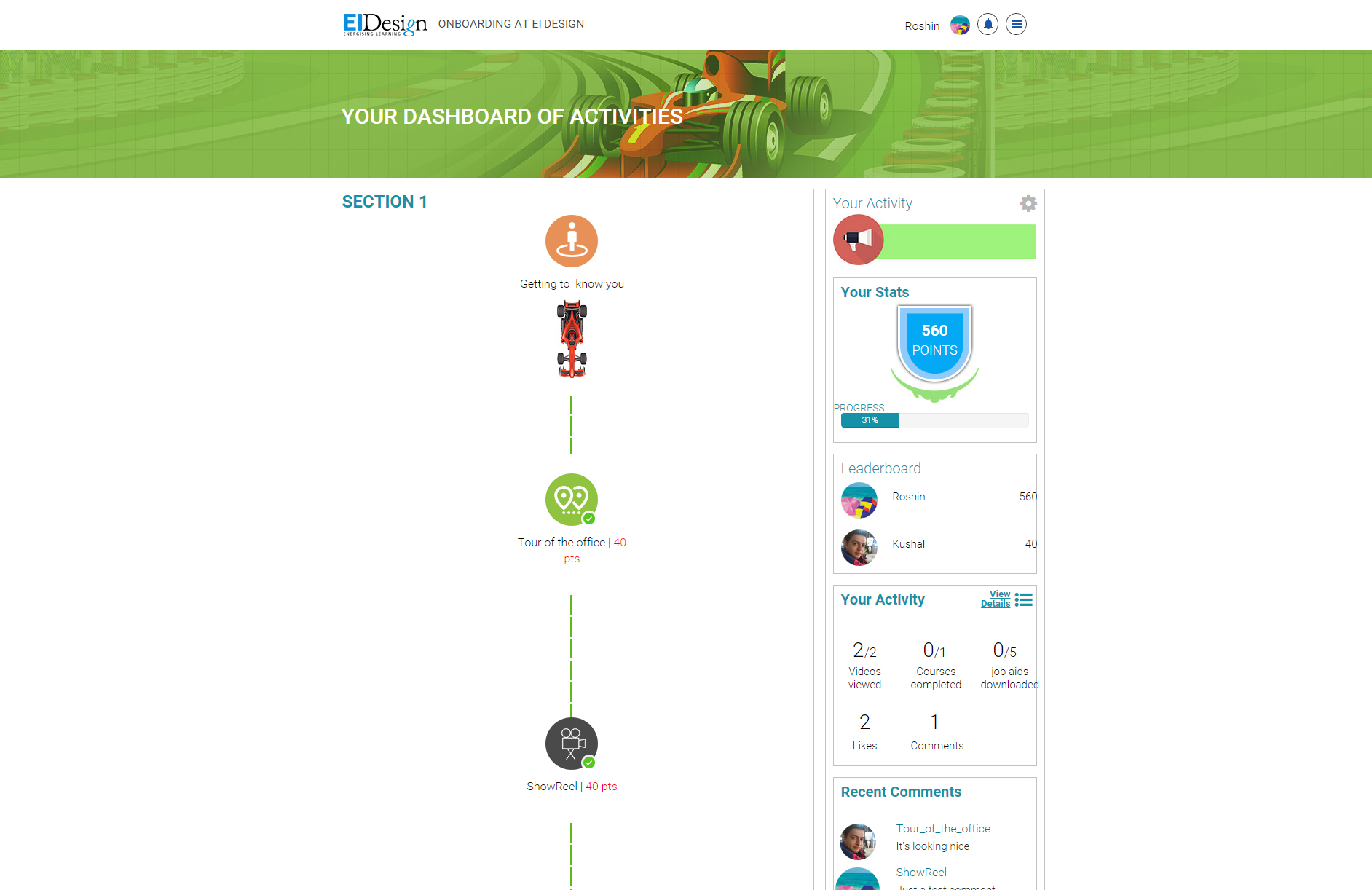
This is one of our latest portal-based solutions to provide our new joinees with an engaging induction and onboarding experience featuring a learning path woven with key information bits about the organization in the form of microlearning nuggets.

The solution is multi-device (runs seamlessly on smartphones, tablets, and desktops). Learners have the flexibility to access the portal on the device of their choice. That’s cool. Well, that’s what they say!

A key element of this engaging journey that the learners go through is the gamified assessment part. There are stages that the learners have to go through and at the end of every stage, they get to play a game that tests their knowledge of the aspects they have learned about the organization in that particular stage.

For each stage, we have provided the learners with a different game. In the end, learners need to clear a final assessment that has also been designed using gamification techniques.

Induction and Onboarding Example

Induction and Onboarding Gamified Assessment


The impact:


Gamification techniques have played a huge role in the success of this induction and onboarding platform, as:
  • Learners (especially new joinees who are Millennials) can relate to them and enjoy going through the portal.
  • They make answering questions about the organization look cool.
  • Learners end up gaining and retaining more information about the organization than they would after a standard Induction session loaded with information-overdose.
  • Bring in an element of variety (the microlearning nuggets are offered in different formats and there is a different game at the end of each stage).
  • They instill a spirit of achievement and recognition as they can see their names feature in the organization’s leaderboard.

Example 2: Employee Engagement


With our gamification solutions, we assure our customers a higher level of learner engagement. That’s exactly what we did when one of our customers sought our help in gamifying a learning solution – we “walked” the talk!

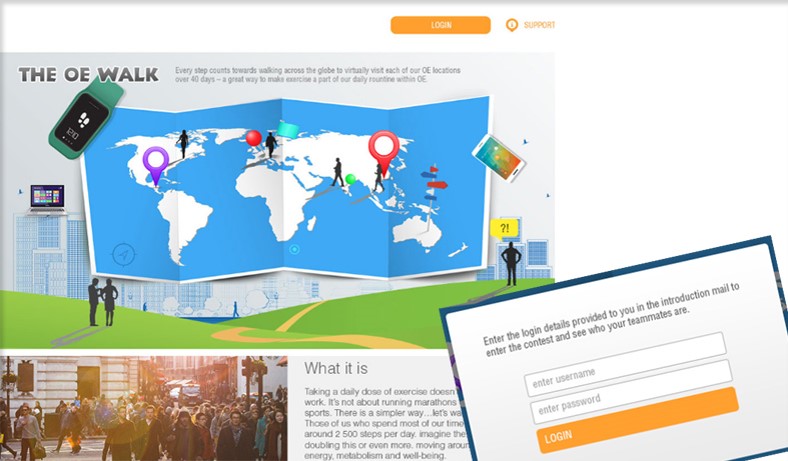
The customer wanted to spread awareness on health issues among their employees. We designed a program that highlighted the advantages of exercises in the form of walking, helping the employees walk virtually between their various office locations, carrying out various team-building and awareness-building activities along the journey.

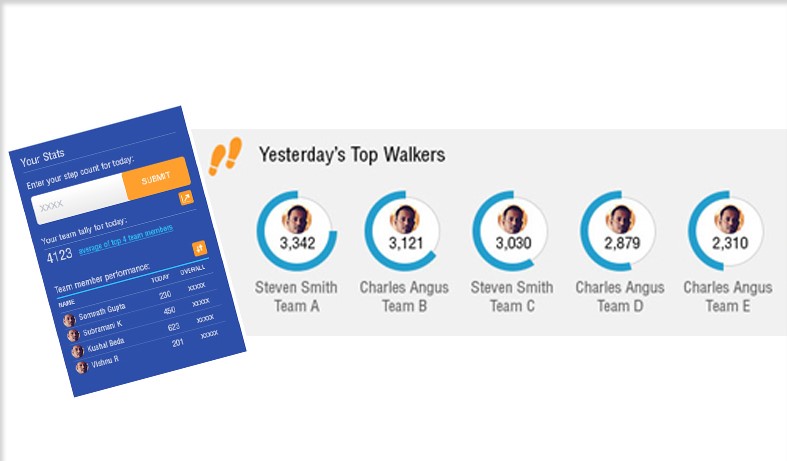
The entire concept was game-based and learners could record the steps they have walked in a day. With an increase in their scores, they would get the opportunity to go to the next location. Learners could create their own profile and be part of a team that would perform different activities along the journey. They could also see the “top walkers” of the day and feel motivated to do better.

Employee engagement Walkathon


Employee engagement Walkathon steps


The impact:


This gamification-based technique created a huge impact as it:
  • Helped the organization channelize its HR initiative in a fun, engaging way.
  • Improved team bonding within the employees of the organization.
  • Encouraged employees to take part and do better than their colleagues.
  • Enabled the organization to fulfil its objective of creating awareness on health issues and bring about greater employee engagement.

Example 3: Application Simulation


Something that you learn in a classroom versus something that you learn by practice or on your own – which learning do you remember more? It’s the latter, isn’t it? How often have we experienced this ourselves? The “Do-it-Yourself” concept works big time and that’s exactly what we tried to do with this gamified Application Simulation solution.

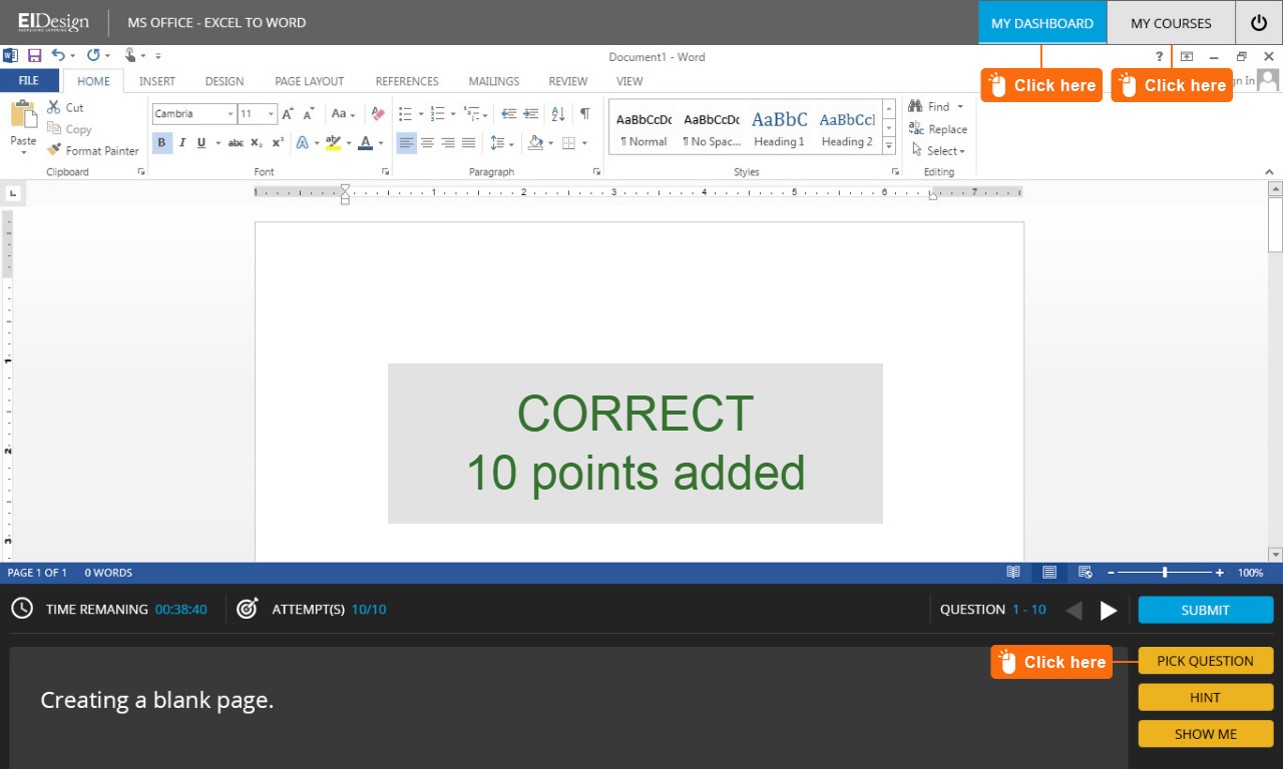
It enables learners to learn MS Office the fun way. They can view demos, try them, and test themselves in real tasks in a real environment. It challenges learners to perform tasks through a point system and provides hints at various stages.

It also helps them to pick and choose what they want to learn and follow that as a learning path, enables them to see the progress of courses, points gathered, rank and leaderboard in a dashboard, and post any questions they have to their guide through the platform.

Application simulation and Gamification Dashboard

Application simulation of Microsoft Word with Gamification


The impact:


Learners found this solution extremely beneficial as it:


  • Allowed them to explore the features of MS Office on their own with the level of assistance that they opted to have.
  • Challenged the learners to do the steps right and enabled them to give their best shot with points at stake.
  • Provided hints to learners if they felt lost.
  • Allowed the learners to choose what they want to learn as opposed to being asked to learn.


Example 4: Compliance


Compliance can be boring. Not with gamification techniques though! This solution of ours showcases how we have conveyed a dry compliance concept in an engaging way using the gamification technique.

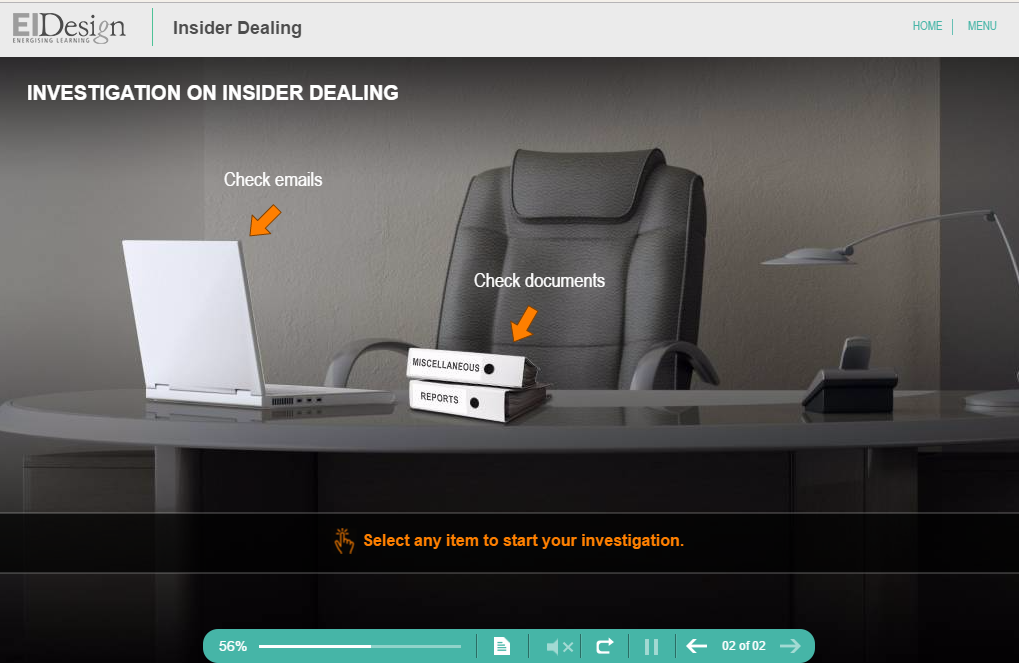
This learning nugget features a mix of gamification and scenario-based learning and explains the concept of Insider Dealing in a nutshell. The learner has to play the role of a Crime Investigator and investigate a case of Insider Dealing involving two characters. The learning journey involves examining the evidences available and taking decisions to progress further in the case to identify the tipper and the tippee. The concept resonates well with learners and they’re able to “bond” well with the subject – they get to feel what it’s like to be in James Bond’s shoes after all!

Compliance course - Insider Dealing

Compliance Course Senario - Insider Dealing


The impact:


The gamification technique along with the scenario-based learning flavor makes this compliance nugget highly effective as:

  • The nugget effectively conveys the concept of Insider Dealing and helps learners understand instances where they may come across Insider Dealing at work.
  • It presents the learners with a challenge right at the beginning and captures their attention from the word go.

Example 5: Skill Development

Account Management is serious business but as Heath Ledger would have said it, a course on the same need not be “so serious”. With this gamification solution, we made understanding concepts related to Account Management fun.

We converted an existing ILT based course to an engaging gamification based learning module. The content was for Project Managers who needed to understand and apply various key concepts related to Account Management which would help them to handle clients better and establish EI Design as a strategic partner for its clients.

We divided the content into levels. Learners had to clear each level to advance to the next with a minimum number of points. In the interim, they would learn through various resources like videos, interactive videos, info nuggets, job aids, and so on, and solve challenges. When presented with a challenge, learners could attempt to solve it directly or seek help from peers (social learning) or an expert.

Skill development - Account Management

Skill development - Account Management example


The impact:


The solution served the purpose of employee skill development as it:
  • Aided better information retention and application of information on the job.
  • Helped increase the module completion rates and brought about learner engagement.
  • Provided the learners with just-in-time support.
  • You can also take a look at this video to see how we have used gamification techniques beyond the simple points and leaderboard approaches to make corporate training engaging.


Source: https://www.eidesign.net/go-beyond-badges-and-leaderboards-5-examples-of-gamification-in-corporate-training/