Wednesday, 25 March 2020

L&D Guide Series – 10 Must-Use Strategies to Engage and Train the Overwhelmed Employees

The Overwhelmed Employee

Today, the concept of work-life balance is getting lost. With the blurred line of when the work ends and personal time begins, the overwhelmed employee is now visible across all industry verticals.
After the widespread usage of smartphones and the ubiquitous Internet, there appears to be no barriers between work and home anymore. Furthermore, with increasing globalization, employees run from a packed workday at office to home – only to take the last call from home or to clear a few emails from colleagues in another time zone.
Although these overwhelmed employees would love to put in lesser hours than what they usually do, the fact remains that a large percentage of the workforce is putting in close to 50 hours per week.
During the workday, there are distractions of incoming emails, messages, plus scheduled concalls or meetings. As a result, the uninterrupted window of time shrinks further and further. If these dynamics are a part and parcel of the employees’ workday (that often stretches to personal time as well), how can the L&D team get to engage them and ensure that they invest the requisite time on training?

Impact on L&D Initiatives: This is a big challenge for the L&D teams as,
Overwhelmed employees = Low engagement and low motivation to invest time on training.
While the average employees put in their best and commit to make a difference at work, they are distracted and find it difficult to concentrate on aspects that make a difference to their performance as well as career progression (this includes investing time on training and other avenues for growth).
Being “wired” all the time eventually takes a toll on the creativity and it also impacts the productivity and performance. It takes the joy away from the accomplishments. As a result, the overwhelmed employees are unlikely to realize their full potential, even though they are working longer hours.

So, how can this be remedied?

The answer lies in adopting an approach to deliver training that syncs up better with the learners’ workday and lifestyle. In this article, I share a few L&D strategies that would help you train the overwhelmed employees.

Despite the Tough Schedules and Ongoing Distractions, What Would Excite the Learners and Motivate Them to Carve Out and Invest Time on Training?

Overwhelmed employees too want to improve their situation. However, they will invest time on learning if it is aligned to their lifestyle and is available within their workflow. Only then will they be motivated to carve out time for training.
Before you draw up a strategy to engage your overwhelmed employees, do take a look at what the employees want and how they want to learn.
  1. The learners want the training to be as seamless and as easy to access as Google or Amazon or Netflix. Each learning experience should lead them up to the next plus give them recommendations.
    • They want to get the right learning resources quickly, easily, and on-demand.
    • They want access to the learning content and resources on the go, on their devices, and they do not want to log in to the LMS every time they have a need.
    • Additionally, they want meaningful recommendations that keep them connected and encourage them to come back for more.
  2. They understand the value of “continuous learning” and expect the L&D teams to provide this environment in the workplace.
  3. The content should be searchable and must be packaged to address specific needs and trigger the desired action.
  4. They need the learning journeys to match their career progression goals and should move up from “learning pathways” to specific “career pathways.”

How Can L&D Teams Change Their Current Approach to Meet This Expectation?

Given the fact that modern learners’ expectations reflect the “new normal,” the L&D teams need to rise to this challenge. Clearly, they need to move away from the prescriptive “push” based training delivery to “pull” based learning experiences.

What L&D Strategies Would Help Engage the Overwhelmed Employees?

At EI Design, we work with several customers to offer learning that aligns better to the learners’ expectations. It is short, focused, and personalized and enables employees to consume this either at the moment of need or during breaks.

I am sharing a list of L&D strategies that have helped us achieve this mandate:


L&D Strategy #1

Add Microlearning nuggets that precede the online training that encourage, motivate, and engage the learners. These could include teasers, highlighting the value for each learner, and how will it help them do their tasks better or upskill or help them fix an identified gap.

L&D Strategy #2

Provide a judicious mix of Macrolearning and Microlearning. Additionally, offer flexibility to consume the training on the go and on the device of their choice.

L&D Strategy #3

Leverage learning design formats that resonate well with modern learners. These could include Microlearning, Video Based Learning, Apps for Learning and so on.

L&D Strategy #4

Invest on strategies that engage and create more immersive learning experiences – notably, Gamification, Branching Scenarios, AR/VR and so on.

L&D Strategy #5

Invest on instant or just-in-time learning aids (Performance Support Tools) that are available in the learners’ workflow and easily accessible when they need them.

L&D Strategy #6

Supplement the primary training with Microlearning challenges (assessments) that facilitate learning retention and based on the learners’ scores, nudge them to review the primary training collateral.

L&D Strategy #7

Have practice zones or avenues to facilitate the application of the acquired learning.

L&D Strategy #8

Provide room to practice and offer learning paths that help learners gain higher proficiency.

L&D Strategy #9

Provide flexibility to learners to create personalized learning paths.

L&D Strategy #10

Enrich the learning by providing recommendations (based on the pattern of learning or learners’ interest) and push Self-Directed Learning.

Additionally, here are some tips that will help you sustain this momentum: 

  1. Limit prescribing – Instead, allow higher control to the learners. Essentially, nudge them towards the required path but don’t push!
  2. Make content available on demand and easy to search and locate.
  3. Encourage participation by opting for techniques like Content Curation and Crowd-sourced assets (these could include videos/links to public domain resources).
  4. Recognize employees who align to the mandate and highlight their contribution in public forums.
  5. Leverage Learner Analytics to assess what the learners’ consumption pattern shows and make further tweaks that can meet the mandate more effectively.

I hope this article provides ideas, techniques, and L&D strategies that will help you engage your overwhelmed employees and meet your mandate.

Meanwhile, if you have any specific queries, do contact me or leave a comment below.

Wednesday, 11 March 2020

How to Use Audience Analysis and Learner Personas to Create a High-impact Learning Experience

Most of us (whether from the Instructional Design or L&D team) are aware of the significance of audience analysis. We know that only when this analysis is correctly applied to identify a learning strategy is when we would see the required gains in enhanced skill, thinking, or behavioral change in the learners.
Yet, quite often, this aspect is driven by assumptions and a limited analysis of what would truly resonate with the learners. Why does this happen?
Here is my take on this gap on audience analysis and how it impacts the eventual gain the learners seek. As Instructional Designers, we want to create courses with a “wow” factor, and this often leads us to opt for learning strategies that excite us, but they do not resonate well with the learners.
While it is important to create learning designs that excite learners, the learning journey must enable them to meet their specific mandate. Only then will they walk away with a sense of fulfilment and accomplishment.
Significance of audience analysis: To understand the learners (as in, by being in their shoes), we need to do an extensive audience analysis. To achieve the learner mandate, we need to understand the learners, think like them, and ascertain what would excite them and, more significantly, what would not.
Specifically, while conducting audience analysis, we need to identify what would help create a sticky learning experience, help them improve their performance, or solve a problem.
Additionally, we need to extend the audience analysis to include what learning strategies would help influence learners’ thinking process and, eventually, behavior.
In this article, I begin with the significance of audience analysis. Then, I take you through the technique of Learner Personas that can be used (in contrast to limited, real user sampling) to help you choose the right learning strategies and design formats that would create high-impact learning experiences.

Why Is Audience Analysis Necessary and How Does It Impact the Learning Design?

Today, Instructional Designers are spoilt for choice with the range of learning strategies and multiple design formats that can be used to craft a learning design. However, this does make the selection process a bit more difficult. How do you select the right option, when more than one approach or a combination thereof can work?
This is exactly where audience analysis helps. It helps us understand:
  • Who are the target learners.
  • What are their preferences (how they want to learn, when and where would they want to learn, what degree of control they require on how they want to consume learning, and so on).
  • What is their current knowledge or proficiency level.
  • What is driving or motivating them.
  • What exactly do they want to accomplish (through training or performance support).
Sounds simple, is there a catch?
Online training typically addresses a wide and heterogeneous set of learners (coming from multicultural backgrounds, different geographies, different age groups, different proficiency levels, and certainly different motivation levels, and so on).
It is practically impossible to interact with each learner to understand what would resonate best with each of them.
This is where the technique of using Learner Personas comes in.
  • By using the technique of Learner Personas, you can identify and select the learning design that will deliver the desired impact.
  • It also helps you eliminate certain options (that may work with certain Learner Personas but not with others).

What Are Learner Personas and How Do They Offer a Better Option as Compared to a Limited, Real User Sampling?

It goes without saying that using cues from real or actual users will lead to a more definitive audience analysis. However, it is very challenging to pool in this data from all users. Hence, we take cues through a partial sampling of the real users, but this may lead to picking up limited cues and not necessarily the overall patterns. On account of this, we can miss the bigger picture and may potentially get a limited impact from the selected learning design.
This is where the use of Learner Personas comes to the rescue and it can aid in helping us hit the bull’s-eye with the right learning strategy.
Learner Personas are fictional learner profiles that are generated through the aggregation of real user data. They are very useful in understanding the target audience in terms of their background, what would motivate them, and how they would like to learn. In fact, Learner Personas are created by using a partial sampling of the real-world users. They enable Instructional Designers to validate what approaches or combination thereof can meet the expectations of different learner profiles.
With Learner Personas, you look at the learning design from the learners’ viewpoint and assess if the selected approach would work or otherwise.
  • You work with more tangible cues rather than assumptions to craft the learning design.
  • Different stakeholders in the project development cycle can use this to validate or tweak their approach and re-draw the learning design suitably.
As a result, you are likely to meet the learners’ mandate without the pain of re-work on the developed training.

How Can You Build Learner Personas?

As I have highlighted, while the Learner Personas are a fictional profile, they draw upon real-world users’ data. This data can be collated through a step-by-step approach to create and refine the Learning Personas.
At EI Design, we use a combination of the following approaches:
Step 1: Have a discussion with:
  1. Project sponsors.
  2. L&D teams.
  3. The Business Unit.
Step 2: Survey/Interview a small group of target learners. If feasible, spend some time with the target user group and observe them.
Step 3: Analysis of past data for projects with a similar mandate to ascertain what worked and what may need to be updated/worked upon to meet the mandate.
At EI Design, we use a simple two-tiered model to create the Learner Personas.
We begin with basic cues on demographics that typically include:
  • Age.
  • Role.
  • Region or Geographic location.
  • Interests.
  • Cultural aspects.
Then, we look at the next tier of cues that typically include:
  1. Learning mandate/needs (What are they exactly aiming to accomplish through the training or Performance Support intervention).
  2. Current proficiency and expected gain.
  3. Motivation factors.
  4. Preferred device to learn (Smartphone/Tablet, Laptop/Desktop, or the flexibility to work across devices).
  5. Preferred approach to learn (Microlearning or Macrolearning as well as different formats).
  6. Preferences for learning strategies (particularly relevant when there are existing training programs).
  7. Preferred mode of training delivery (prescribed learning path, Personalized path, or customized path).
The value of using Learner Personas is in working with a bigger picture that increases the ability to achieve the learner mandate through the most appropriate learning design.
I hope this article will help you in crafting more effective learning experiences by leveraging the technique of Learner Personas. These learning strategies will resonate better with your learners and deliver the required value to them as well as to the business.
Meanwhile, if you have any specific queries, do contact me or leave a comment below.
Wednesday, 29 January 2020

How to Blend Microlearning and Macrolearning to Deliver a Higher Impact Workplace Training

Today, Microlearning based training has become a significant mode for online training delivery and the following stat reaffirms it further:
“The global microlearning market size is expected to grow from USD 1.5 billion in 2019 to USD 2.7 billion by 2024”.
Source: MarketsandMarkets
However, organizations will continue to have Macrolearning needs too. Given the value that each one of them offers, it is important to see how the two can be leveraged by arriving at the optimal blend of Microlearning and Macrolearning.
In this article, I begin with the definition of Microlearning, its value for learners and L&D teams, and list where it works well. I highlight areas where Microlearning would not work and Macrolearning would indeed be the better fit. Finally, I outline how you can arrive at the optimal blending of Microlearning and Macrolearning to deliver a high-impact workplace training.

Microlearning and Macrolearning – The Difference

While Microlearning is all about short bites of learning and is the talk of the season, it is not a new concept. For years, Instructional Designers have been chunking content and mapping them to enabling outcomes (much the same way we do for Microlearning). This would map to multiple topics that would then get packaged into a single course (or Macrolearning).
  • Macrolearning looks at the bigger picture and is typically associated with longer seat times that cover complex concepts. It also offers a range of associated concepts in the same course.
  • In contrast to Macrolearning, Microlearning focuses on achieving a specific outcome or gain over a short seat time.

What is Microlearning, and What Value Does Microlearning Offer to the Learners and L&D Teams?

Microlearning features focused learning nuggets ideally designed to be 2-5 minutes long and normally not exceeding 7 minutes. It is supported across all devices – enabling the learners to move across devices (from a desktop/laptop at the office to their tablet/smartphone). Its short seat time enables it to be the preferred training to be consumed “on the go” on their smartphones.
However, Microlearning is not just splicing the bigger chunk of content into shorter nuggets.
  • It must help learners achieve a specific gain/a learning take-away in the short burst.
  • It should trigger the right action (learn more, practice, take a challenge, or apply).
Learners love Microlearning based training as:
  1. It is short and focused.
  2. It can be taken on the go.
  3. It is available to them within their workflow and they can access the nuggets exactly when required (rather than having to log on to the LMS and search).
  4. It gives the control to the learners and they can decide when they want to consume the content (as well as how and at what pace).
  5. It uses formats that are more engaging and create a more immersive learning experience. As a result, they resonate better with them (notably, videos).
L&D teams see value in Microlearning based training on account of:
  1. Its ability to engage learners across profiles, that is, today’s multi-generational workforce.
  2. Its ability to provide a sticky learning experience.
  3. Its high completion rates.
  4. Its ability to help learners apply the learning on the job so that both learners and the business get the gain they sought.
  5. Its approach of threading multiple nuggets over a learning pathway helps learners learn, apply, practice, and hone their skills. This leads to the desired proficiency gain and can also influence or trigger behavioral change.
  6. Its ability to refresh and reinforce learning that keeps the “Forgetting Curve” at bay.

Where is Microlearning a Better Fit as Compared to Macrolearning?

Here are some ways to effectively use Microlearning rather than Macrolearning:
  1. To create awareness or highlight value. You can offer Microlearning Videos to highlight the value of the upcoming training and create interest and motivation among learners.
  2. For Formal Training. You can use Microlearning to address a percentage of your corporate training needs. This can be rendered as a series of nuggets that are threaded through a learning path.
  3. Supplement Formal Training (including aids for performance improvement). You can also use Microlearning to supplement your Formal Trainings. The nuggets can provide support to the Formal Training through reinforcement, apply, or practice. You can also provide them as just-in-time job aids.
  4. To support ILT training /VILT sessions. You can use Microlearning nuggets at 3 levels (Pre-workshop prep/reading material, exercises or role-plays during workshop, and post-workshop learning summaries or learn more).
  5. For Collaborative Learning.

When Would Microlearning Not Work?

Microlearning may not work in situations where the training program is long and complex (that is, trainings that have complex concepts and nested learning pieces). In such situations, it makes more sense to present the training as a single larger learning unit.
Breaking down such content into multiple nuggets can be counterproductive. It would create a rather disruptive learning experience and will impact the learning takeaways adversely and a Macrolearning based approach would be the right mode, instead of Microlearning.

How Can You Blend Microlearning and Macrolearning Techniques to Deliver a Higher Impact Workplace Training?

Approach 1: Leverage on Microlearning by Using It to Supplement Macrolearning
  1. Teaser/Awareness videos: These nuggets can be used prior to the main Compliance training to create awareness and establish the significance for the organization and the learners. This will increase the learner engagement as well as improve the spirit of “why comply.”
  2. Learning Summaries/Reinforcements/Micro-challenges: These nuggets can help the recall, retention, practice, and apply learning acquired through Macrolearning.

Approach 2: Use Microlearning Techniques to Craft Richer Macrolearning Courses

As a lot of Mobile Learning courses move from the “Mobile Friendly” to the “Mobile First” approach, learners are consuming this content predominantly on smartphones.
These provide a great opportunity to use Microlearning techniques that can be embedded within Macrolearning courses to create higher engagement.
For instance, you can embed:
  1. Video to establish the value of the course (What Is In It For Me/WIIFM). This could be a part of the course or could be released prior to the training roll-out.
  2. Video Based Learning nuggets in different formats, notably Explainer videos for teaching concepts, can be integrated into the Macrolearning course (in lieu of the standard interactions).
  3. Learning summaries, Cheat Sheets, or Ready Reckoners can be designed in Microlearning formats like Infographics, Interactive Infographics, Interactive pdfs, Flipbooks, and so on. These can be easily downloaded by the learners and accessed on their smartphones.
I hope this article provides a balanced view on the question of Microlearning vs Macrolearning. Both techniques offer unique values and will continue to co-exist. In the future, you will see a use of blended Macrolearning and Microlearning techniques that can create higher impact workplace trainings.

If you have any specific queries, do contact me or leave a comment below.

Tuesday, 14 January 2020

How to Fast-Track Your Sales Training with Mobile Learning

In terms of significance, Sales training would rank possibly next to Leadership training for most organizations. As we know, without effective sales teams, even the best of the business plans will go awry. To succeed, organizations need to offer Sales training that is highly focused and is well aligned to help meet their business plan.
An effective Sales training:
  • Should equip the teams to understand customers better, have the right resources to pitch, outsmart competition, and close leads.
  • Should help sales teams create further connects to upsell or cross-sell.
  • Should help them counter competition.
Once these are in place, sales teams can maintain a connect with customers and build strong, deep relationships so that they can steadily increase their wallet share of business.
Mobile Learning is a highly effective approach to offer Sales training and meet these objectives.
In this article, I show you how you can fast-track Sales training with Mobile Learning.

What Is the Gain (for Learners, Business, and L&D teams) as Organizations Opt for Mobile Learning for Sales Training?

The Value That Mobile Learning for Sales Training Brings to Learners
Mobile Learning is the preferred mode of learning for Sales training on account of its ability to:
  • Provide training that is available anytime, anywhere (on the go).
  • Offer flexibility to consume training at the moment of their need – on the field, during commute, or while waiting.
  • Offer control to learners to decide the pace at which they want to consume it.
The Value That Mobile Learning for Sales Training Brings to the Business
From an organizational perspective, the usage of Mobile Learning for Sales training enables organizations to:
  • Reach a geographically spread out audience in a short time.
  • Ensure a consistent message reaches the sales team.
  • Leverage it to offer on-the-job training that can deliver results faster.
  • Ensure the latest updates are made quickly and deployed quickly.
The Value That Mobile Learning for Sales Training Brings to the L&D Teams
Mobile Learning is versatile and can address the complete spectrum of Sales training needs including:
  • Formal training (Online or to support facilitated sessions).
  • Provide instant learning aids/job aids.
  • Leverage Social or Collaborative Learning.
This is not all. The training can be deployed quickly to a geographically spread out team and tracked on how it was consumed by learners.

What Are the Options through Which You Can Craft Mobile Learning Based Sales Training?

At EI Design, we have been crafting effective Sales trainings for over a decade now and I pick several tips and best practices that you can use.
Let’s begin by taking a look at the wish list that typical learners (from sales teams) would have for their training and see how Mobile Learning ticks all the boxes for Sales training.
What Learners Want
  1. On-demand content.
  2. Resources that are easily accessible (at the moment of their need).
  3. Relevant and relatable content.
  4. Engaging and immersive learning experiences.
  5. Challenging and rewarding experience.
What the Chosen Approach Must Offer to Fast-Track Sales Training
  1. Access to training – anywhere, anytime.
  2. Info should be current and must be updated quickly, and these updates should pro-actively reach the learners.
  3. Facilitate recall, retention (sticky learning).
  4. Help them apply the acquired learning.
  5. Provide room for practice (in a safe zone).
  6. Provide feedback that can help learners improve.
  7. Provide room for reinforcement.

What Kind of Solutions Will Help You Fast-Track Sales Training with Mobile Learning?

Part 1: Design
Microlearning: Short, focused, action-oriented learning nuggets are ideally suited for Sales reps who are always on the move. You can leverage on the granularity of Microlearning based training to offer learning paths that have multiple short nuggets to suit different aspects of learning needs.
Microlearning based training is very versatile and you can use it to offer a combination of:
  • Formal training: Through a series of nuggets where each nugget helps learner accomplish a learning goal.
  • Just-in-time/Instant job aids: These are of great value for the sales teams as they provide the requisite support exactly when needed. These could include Quick Reference Guides for products, Cheat Sheets, Ready Reckoners, Competition Watch, Success stories, and so on.
Additionally,
  • You can offer Personalized learning paths that can be created by the learners (based on their proficiency).
  • You can opt for Mobile Apps for learning that enable you to offer a more Personalized journey as well as just-in-time updates.
  • You can integrate Video Based Learning for both formal learning as well as for performance support.
  • You can go a notch up on classic videos by opting for Interactive Video Based Learning.
Part 2: Learning Strategies
 There are several learning strategies that can help you fast-track your Sales training with Mobile Learning. In particular, you can leverage on the following three:
  1. Scenario Based Learning: This can be used to teach several skills that are mandatory to handle sales (pitch, presentation, objection handling, negotiation, and so on).
  2. Decision-making simulations: These can be used to hone skills like critical thinking, decision making, understanding the impact of choices (in a safe zone).
  3. Gamification: Sales teams are aligned to targets and have a competitive spirit. They respond well to Gamified learning that can help them assess where they stand or simulate how they are faring against other teams.
Part 3: Use Mobile Learning to Offer a Complete Sales Toolkit – Can Be Used at the Moment of Need
The real power of Mobile Learning for Sales training is in its ability to cover the entire spectrum of learning needs for sales teams.
Take a look at the 10 significant ways you can leverage Mobile Learning for your Sales training. You can convert these into a Sales Toolkit, which can be used at the moment of need.
  1. What Is In It For Me (WIIFM) and the value the program brings in for the learner.
  2. Product Fact sheets.
  3. Reports and ongoing dynamic updates on:
    1. Market dynamics.
    2. Competition watch.
  4. Learning aids or instant job aids to pitch – These could include how to differentiate and how to handle competition.
  5. Cheat Sheets or FAQs – On Objection handling, Negotiation, Closure, and so on.
  6. Tips for upselling or cross-selling.
  7. Case studies or Success stories.
  8. Reflection zone.
  9. Collaborative Learning – with peers or seniors.
  10. Curated Learning Resources – Explore and Learn.

I hope this article gives you good insights on how you can use Mobile Learning to fast-track your Sales training. If you have any specific queries, do contact me or leave a comment below.

Tuesday, 31 December 2019

How Can You Use Personalized eLearning to Drive Employee Performance and Achieve Higher ROI

My free eBook, How Can You Use Personalized eLearning to Drive Employee Performance and Achieve Higher ROI, is designed to help you understand the value in adopting Personalized eLearning.
It additionally provides insights on how it can be used to craft learning experiences that are relevant and engaging. As an extension, they provide demonstrable gains for learners and businesses, leading to a higher ROI.

How Will the eBook Help You?

eLearning and, notably, Mobile Learning are fast becoming an integral part of an organization’s training delivery.
  • Learners love the flexibility it offers (training on the go and on the device of their choice). Plus, they can consume it at the pace they are comfortable with.
  • Organizations see a significant gain in being able to reach a wider audience with a consistent message and track the progress effectively.
With this gain comes an associated challenge. While eLearning or Mobile Learning enables organizations to reach a wider audience. The same program gets rolled out to a heterogeneous audience that may have differences on account of:
  • Learner proficiency.
  • The learner’s role.
  • Learning style.
Personalization of eLearning is an effective approach to address this gap. It enables you to not only reach a wider audience but design more engaging, customized and highly relevant learning experiences.
Unlike the “one size fits all” approach, Personalized eLearning provides a far more immersive and meaningful learning experience to learners.
In this eBook, How Can You Use Personalized eLearning to Drive Employee Performance and Achieve Higher ROI, I outline how you can practically adopt Personalized eLearning for your varied corporate training needs with a focus on driving the employee performance as well as a higher ROI.
Do watch my webinar on the same topic – How Can You Use Personalized eLearning to Drive Employee Performance and Achieve Higher ROI.
Loaded with examples and live demos, this webinar will provide ideas that you can use to offer Personalized eLearning for your key training needs.

Table of contents of the eBook, How Can You Use Personalized eLearning to Drive Employee Performance and Achieve Higher ROI

The eBook is divided into 4 sections, and as is the case with my other eBooks, I use a Q&A based approach.
The key questions that I address are: 
  1. What is Personalized eLearning?
  2. What are the benefits of Personalized eLearning for the learners and the organization and how does it drive better performance?
  3. How can Personalized Learning help L&D teams in the development of employees?
  4. What are the learner’s needs and how can these be addressed through Personalized Learning?
  5. Can all trainings be mapped to a Personalized Learning based approach?
  6. What kind of trainings can leverage on the Personalized Learning based approach?
  7. What are the other measures that can enhance the impact of Personalized Learning?
  8. What are the techniques that you can use to offer Personalized Learning?

Here is the overview of the eBook:

Section 1: Personalized eLearning – Definition and Benefits
This section provides the definition of Personalized eLearning and lists the benefits it offers to the learners and the organizations (focusing on its ability to drive employee performance).
Section 2: How Personalized Learning Enhances the Development of Your Employees
This section provides insights on how L&D teams can leverage on Personalized eLearning to drive employee performance.
Section 3: Adopting Personalized eLearning – 6 Questions Answered
This section is designed to be a micro guide and it features 6 questions that are likely to be on your mind as you plan to adopt Personalized eLearning.
These range from the value it offers and how exactly does it help. This section also outlines the kinds of trainings that can be Personalized and other supporting measures that will help you increase their impact further.
Section 4: Techniques You Can Use to Offer Personalized eLearning
This section outlines the various techniques or approaches that you can pick from to offer Personalized eLearning for your organization.

The Value and Impact of Personalized eLearning

Learner-centric approach: We are moving towards training delivery that empowers learners and provides them the requisite control. Personalized learning is a great learner-centric technique that provides a unique and custom learning experience to each learner. It also provides them the control to select the learning path based on his or her interest, existing knowledge, or the demands of his or her role.
Impact on ROI: On account of better motivation, higher engagement, improved completion rates, and increased application of the acquired learning, the usage of Personalized learning will show a better ROI on the training spend.
This is not all. It encourages a “pull” based consumption as well as self-directed, continuous learning and you can use this to eventually trigger behavioral change too.
I hope this eBook, How Can You Use Personalized eLearning to Drive Employee Performance and Achieve Higher ROI, will provide the required insights on how you can leverage on Personalized eLearning to drive employee performance and see a better ROI on your training spend.
Do download my eBook, How Can You Use Personalized eLearning to Drive Employee Performance and Achieve Higher ROI.
If you have any specific queries or would like to see how we can help you achieve your mandate, do contact me.

Monday, 30 December 2019

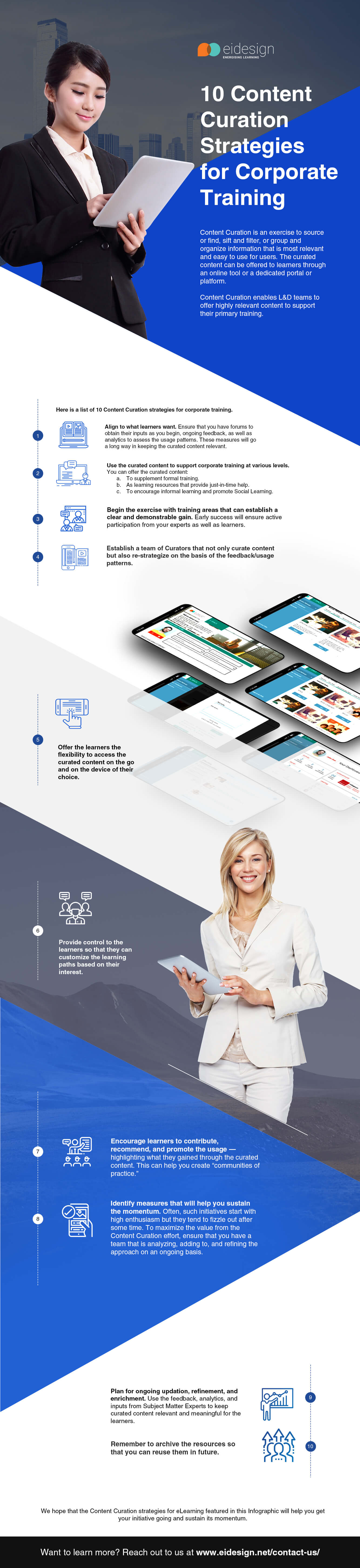
10 Content Curation Strategies for Corporate Training

The Internet may give us data in seconds, but this often requires us to go through a maze of options before we get what would work best for us. This gap can be addressed through Content Curation that provides users the curated or relevant information they seek.
The use of Content Curation for corporate training is on a steady increase and it is being leveraged by L&D teams to support formal training as well as informal training.
  •  It is also a great booster for Self-Directed Learning.
  • It enables organizations to mine their existing knowledge bank and ensure that selected, curated content can equip their learners with right information.
Take a look at this Infographic where we list 10 Content Curation strategies for eLearning that you can use to enhance the impact of your corporate trainings.

Content Curation Strategies for Corporate Training

Content Curation enables L&D teams to offer highly relevant content to support their primary training. Its key value-adds are:
  1. Content Curation provides a repository of relevant and meaningful resources that can be accessed easily from a central location.
  2. It empowers L&D teams, Subject Matter Experts, and learners alike as they can play an active role in the process of Content Curation.
  3. You can use the opportunity of Content Curation to motivate your learners and recognize the team members for their active contribution, usage, and recommendations.
  4. Content Curation is a great way to foster a culture of continuous learning.
  5. It encourages informal learning (just-in-time learning that is particularly useful for Performance Support intervention) and, more specifically, Self-Directed Learning.
  6. Content Curation promotes inclusive learning and allows the knowledge base to be continuously enriched by learners’ contributions. (While this would need a team to audit the new resources, this would also keep the curated content dynamic, relevant, and aligned to what learners want).
Want to learn more? Reach out to us.