Friday, 4 October 2019

Top 10 Microlearning Trends in 2019

Microlearning consists of short, bite-sized learning nuggets. Although short in run length (between 2-5 mins and, typically, not exceeding 7 mins), each nugget is action-oriented and designed to meet a specific learning outcome. In the last couple of years, Microlearning has moved from being a player on the side to center stage and for good reasons.

In a world that is full of distractions and diminishing attention spans, it is critical to have sharp, focused learning nuggets. Only then do you get the learners’ attention and they will invest on completing it. This is precisely what a Microlearning based training delivers.

In this video, we share Top 10 Microlearning Trends in 2019 that you must leverage on and boost employee performance.

We hope the Microlearning Trends featured in this video give you the required insights on why you should invest them into your learning strategy. 

Want more? Book a free consultation with us to learn how you can leverage on the featured Microlearning Trends in 2019!

Friday, 20 September 2019

Gamification Trends in 2019 – Packed with Tips and Ideas You Can Use

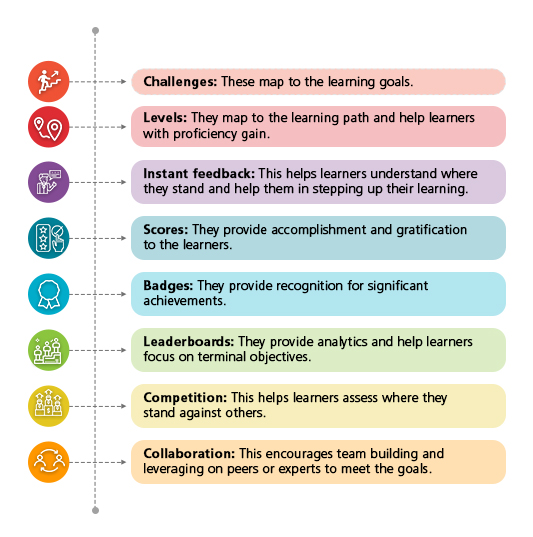
Gamification is the use of principles and key elements of gaming to deliver the required learning objectives. The key elements of the Game mechanics that are a part of Gamification for learning include:

Key elements of the game mechanics that are a part of Gamification for learning
While “Have fun as you learn” resonates well with learners, these approaches are often looked at with skepticism by the corporates. Of the various myths associated with what Gamification can do/can’t do, I list the three I have encountered the most:
  • Gamification in eLearning doesn’t really help learners learn.​
  • Gamification adds fun to learning but does not drive learner performance.
  • Gamification appeals only to millennials.

The fact is that well-designed Gamification based trainings provide help to both organizations and learners at many levels.

The value from the learners’ perspective: The value Gamification based trainings bring in is re-affirmed by user feedback too. I list part of the findings from Talent LMS’s Gamification at work survey in 2018:
  1. 80% of employees enjoy using Gamification software at work.
  2. Employees feel that Gamification makes them more productive (87%), more engaged (84%) and happier (82%) at work.
  3. 75% of respondents who play games often were more likely to agree that they’d be more productive if their work was made more game-like.
  4. Older employees are more motivated by game elements than younger employees

The value from the organizational perspective: The use of Gamification for learning provides several benefits to L&D teams:
  1. Gamification is a very engaging learning strategy and when crafted right, it helps the L&D teams meet the learning outcomes (similar to other strategies used in traditional eLearning).
  2. Because of a higher engagement quotient, a Gamification strategy provides higher completion rates as well as a better recall and retention.
  3. Gamification can be applied to meet various cognition levels—to help learners learn, practice, apply, or upskill. When applied over a period of time (spaced repetition), it can trigger the desired behavioral change.

Without further ado, here is my list of a few Gamification Trends that are worth a closer look.
For each Gamification trend, I provide practical tips on why and how they can be used.

  Gamification Trend 1

Gamification Trend #1: Maturing of Gamification for learning

This year shows a maturing of the usage of Gamification without the hype we have seen so far. It is coming of age and is moving beyond badges and leaderboards.
Today, it is much easier and quicker (and cheaper) to craft effective Gamification solutions on account of the maturing of authoring tools. There are several Use Cases that show what strategy works and what doesn’t. There is also a shift from Game based learning to using Gamification techniques at various levels.
Tips
Much in line with traditional eLearning, you can use elements of Gamification:
  • For skill building and proficiency gain.
  • To help application of learning on the job.
  • To influence behavioral change (through a longer-term implementation).

 Gamification Trend 2

Gamification Trend #2: Acceleration in adoption with an increase in Mobile Learning and Microlearning

The year is also witnessing an acceleration in the adoption of Gamification as more organizations opt for Mobile Learning and leverage on Microlearning based training formats.
Tips
You can opt for Gamification approaches that are bite-sized and optimized for smartphones. They provide learning on the go and can be designed to facilitate application on the job or help learners in proficiency gain.

Gamification Trend 3

Gamification Trend #3: Wider range for application areas

With more and more successful Use Cases, Gamification techniques are being applied at various levels.
Tips
You can use Gamification (partial or full) as follows:
  1. To make traditional eLearning courses interesting by using partial Gamification techniques.
  2. Fully Gamified approaches to address varied training needs (includes formal, informal, collaborative, and performance support intervention).
  3. To support and pep up ILT programs through Gamified learning aids.
  4. Gamified portals.
  5. Game based learning.
NOTE: I see an acceleration in the adoption of Gamification, particularly in the first three formats rather than the Game based learning. The Gamified portals can be applied for certain niche applications. We have used them for Induction and Onboarding with success.

 Gamification Trend 4

Gamification Trend #4: Usage across varied corporate trainings

With the maturing of the Gamification practice, partial or fully Gamified strategies are being used to address most of the corporate training needs.
Tips
There are several Use Cases that showcase the successful implementation of Gamification for learning across various corporate trainings. You can certainly evaluate using Gamification for:
  • Induction and Onboarding.
  • Sales training.
  • Leadership training.
  • Professional Skills training.
  • Application Simulations training.
  • Compliance training.

Gamification Trend 5 

Gamification Trend #5: Moving toward the use of Next Gen Gamification techniques

Next Gen Gamification techniques reflect a combination of several best sellers like Microlearning and Apps for Learning to deliver impactful training.
Tips
The adoption of these techniques will help you uplift the impact of your trainings manifold.
  1. Longer-term Gamification: Behavioral change requires the usage of Gamification over a long period of time. You can create a learning path that keeps the learner aligned to these goals over multiple weeks/months/quarters.
  2. Multiply the impact: To make the learning journey more interesting, you can add immersive approaches like Virtual Reality or Wearable Tech into your fold.
  3. Leverage on Microlearning based Gamification: Give the learners a “bite-sized” Gamification experience that can be consumed on the go. These could include a challenge (a set of Gamified questions) or a Micro-Game (mapping to a specific outcome).
  4. Personalized Gamification: Based on the current knowledge (validated through a Pre-Test), you can offer personalized learning and Gaming paths for learners.
  5. Social Learning based Gamification: Let the learners collaborate with peers to meet a challenge. Or, provide the support of experts to help them solve a problem.
  6. Invest on niche Gamification portals: These can be designed to offer customized learning paths and elements of Gamification, Microlearning, and Social Learning.
So, how can you make Gamification based training work for you?
To maximize the impact of Gamification based trainings, it is good to work with a bigger picture and use these techniques at various levels. Here are some measures that we have successfully used:
  • Step 1: Identify barriers (intrinsic or extrinsic) that might be hindering the required changes and thereby improve the learners’ motivation levels.
  • Step 2: Generate interest for learning by providing relevant and personalized learning paths.
  • Step 3: Create effective learning experiences using scenarios, simulations, and challenges.
  • Step 4: Provide feedback for performance improvement that can help learners pause and think or recalibrate their way forward.
  • Step 5: Use rewards and recognition to sustain the learners’ momentum and motivation and ensure that they walk away with a sense of accomplishment.
  • Step 6: Implement repetition and reiteration for a successful change in behavior
Gamification is a great strategy to provide an immersive learning experience. When designed well, it provides an engaging learner experience that is action-oriented, aligned to learning goals, and helps learners walk away with a sense of achievement.
I hope this article provides you the pointers to increase the use of Gamification based learning solutions in your organization. If you have any specific queries, do contact me or leave a comment below.

Tuesday, 10 September 2019

Free Webinar - Microlearning In Action

Join Free Webinar on Microlearning In Action - Tips, Techniques, And Examples On How To Use It To Drive Employee Performance. 

Registration Here - https://elearningindustry.com/webinars/microlearning-tips-techniques-examples-drive-employee-performance

Youtube Link - https://www.youtube.com/watch?v=hFD_mKmtMv8

Thursday, 11 July 2019

Mobile Learning Trends for 2019

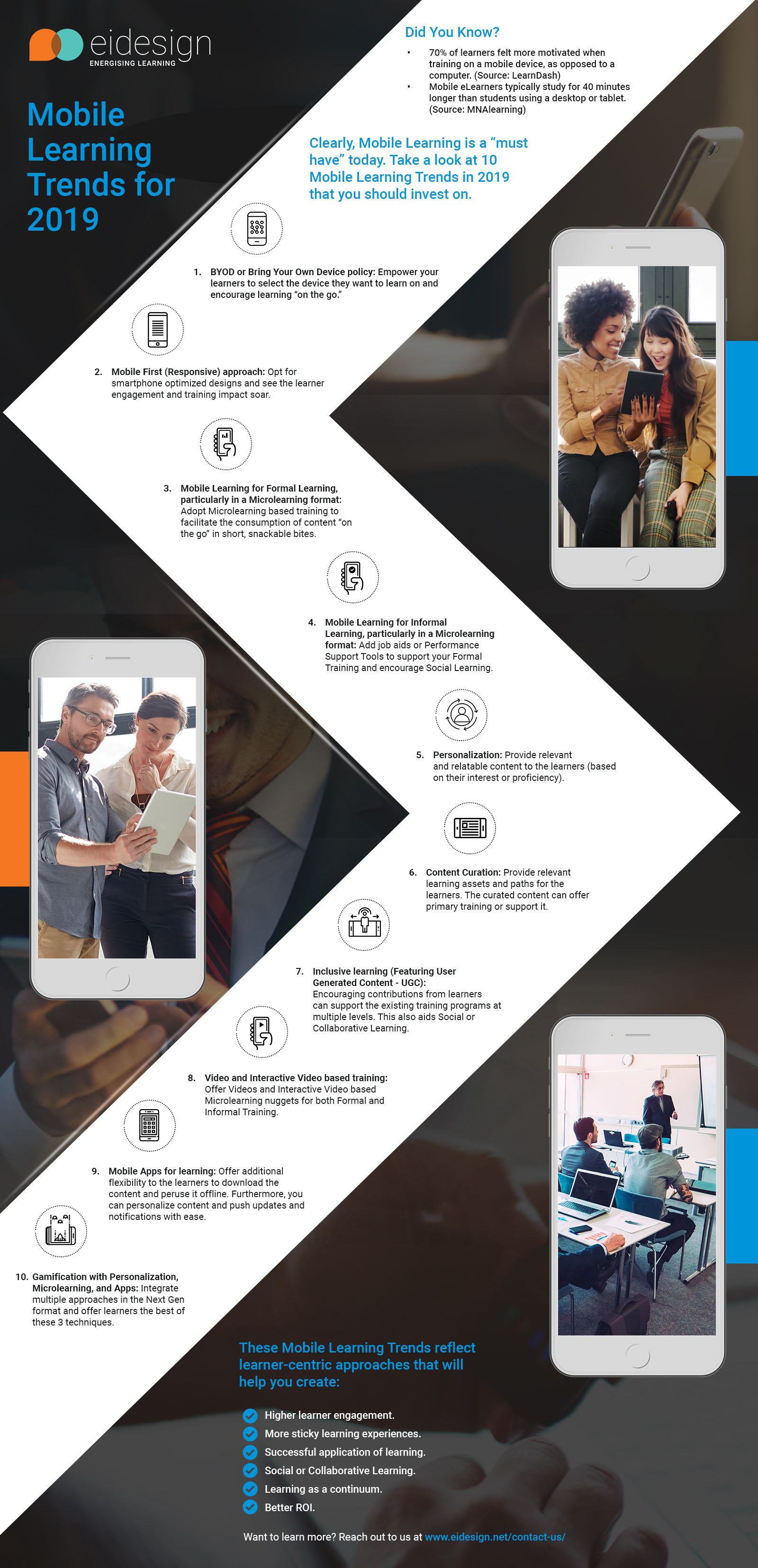
As the Mobile Learning solution becomes a “must have” from a “good to have” solution, the focus shifts to what measures you should adopt to maximize its impact.
Look no further—our Infographic on Mobile Learning Trends for 2019 provides precisely the pointers that you can use to enhance your online training delivery.
With this adoption, this is the impact that you will see:
  • Higher learner engagement.
  • Better completion rates.
  • A sticky learning experience.
Infographic Mobile Learning Trends 2019
Mobile learning trends 2019 -Infographic

We hope this Infographic provides the required pointers on how you can use these Mobile Learning Trends to enhance the impact of your online training delivery. Want to learn more? Reach out to us at www.eidesign.net/contact-us/

Source: https://www.eidesign.net/mobile-learning-trends-for-2019

Wednesday, 13 March 2019

Microlearning Trends To Adopt In 2019

As microlearning-based training moves to center stage, I outline what is driving its rapid adoption. In this article, I also share microlearning trends in 2019, and how you can leverage them to boost employee performance.

Discovering All About Microlearning Trends In 2019

Microlearning consists of short, bite-sized learning nuggets. Although short in run length (between 2-5 mins and, typically, not exceeding 7 mins), each nugget is action-oriented and is designed to meet a specific learning outcome.
In the last couple of years, microlearning has moved from being a player on the side to center stage and for good reasons.
In a world that is full of distractions and diminishing attention spans, it is critical to have sharp, focused learning nuggets. Only then do you get the learners’ attention, and they invest in completing it. This is precisely what microlearning-based training delivers.

Learners love microlearning-based training as:
  • It is short and focused.
  • It can be taken on the go.
  • It is available in the learners’ workflow and can be accessed at the moment of their need.
  • It is designed for multi-device support and provides control to learners on when and how they want to consume it.
  • It uses high-impact formats (notably, videos) that are engaging and immersive.
L&D teams see value in microlearning on account of:
  • Its ability to engage the learners across profiles, that is today’s multi-generational workforce.
  • Its ability to provide a sticky learning experience.
  • Its high completion rates.
  • Its capability to push acquired learning to the application on the job.
  • Its concept of learning paths or learning journeys that can help learners gain proficiency as well as trigger the required behavioral change.
  • Its innate strength to offset the “forgetting curve” and convert it to the “retention curve” through ongoing reinforcements.
Based on our long experience in developing Microlearning based training, and what we see in the near future, here is my view of microlearning trends in 2019.

Microlearning Trend #1 In 2019

Microlearning will be used for a wider spectrum of corporate training, specifically for:
  1. Change management
  2. Awareness programs
  3. Formal training
  4. Just-in-time training (Performance Support Tools or job aids)
  5. Informal learning
  6. ILT support aids

Microlearning Trend #2 In 2019

Microlearning will leverage mobile learning further—particularly, apps for learning: Building on the wider adoption of mobile learning in organizations, it will be the mode L&D teams would prefer for varied corporate trainings.
It will leverage particularly on formats like mobile apps for learning where a personalized learning path with microlearning nuggets can be offered to learners. This approach can be used to provide both formal training as well as just-in-time learning aids within the learners’ workflow.

Microlearning Trend #3 In 2019

Microlearning will use personalization techniques to offer highly customized and relevant learning to each learner.

Microlearning Trend #4 In 2019

Microlearning will capitalize on Artificial Intelligence (AI) and analytics to offer support and personalized learning paths. Furthermore, its capability to offer recommendations to learners will ensure that they come back for more even after completing the prescribed training.

Microlearning Trend #5 In 2019

Microlearning will continue to use video-based learning as a significant design strategy. However, it will see an increase in the NextGen format, that is, interactive video-based learning.

Microlearning Trend #6 In 2019

Microlearning will be used in formal training in conjunction with successful, engaging, and immersive strategies like:
  1. Virtual Reality
  2. Gamification
  3. Scenario-based learning extended through a master narrative or story-based learning
  4. Complex, branching simulations for decision making

Microlearning Trend #7 In 2019

Microlearning will be used extensively in content curation to provide “learning as a continuum”. This will help organizations create a better learning culture and facilitate informal learning.

Microlearning Trend #8 In 2019

Microlearning formats will also help in promoting collaborative or social learning.

Microlearning Trend #9 In 2019

Microlearning will continue to the preferred format to offer just-in-time training (Performance Support Tools or job aids).
Here, most of the established formats will continue. These include the popular and effective ones like:
  1. eBooks/Flipbooks
  2. Infographics
  3. Interactive infographics
  4. PDFs
  5. Interactive PDFs

Microlearning Trend #10 In 2019

Microlearning will support ILT trainings and VILT trainings by providing online resources:
  • Pre-workshop prep material
  • In-workshop exercises, role plays, simulations and so on
  • Post-workshop handouts

Impact Of Microlearning In 2019

Microlearning-based training is no more a buzz. It is a technique that has transformed the online training format and is here to stay.

NOTE: The usage of microlearning does not mark the demise of macrolearning or what is termed as traditional eLearning format. For instance,
  • This would still find its place in programs that need longer seat time, as breaking them into too many nuggets can create a disruptive learning experience.
  • For certain programs like compliance, several organizations will continue to use the more traditional format.
On the other hand, there would be a rapid adoption in programs like:
  1. Induction and onboarding
  2. Sales training
  3. Leadership training
  4. Professional skills training
I hope this article throws light on the possibilities of using microlearning in 2019 as a significant part of your online training delivery or to support your Instructor-Led Training.
If you have any queries or need any specific support, do contact me at apandey@eidesign.net.

Wednesday, 6 March 2019

4 Easy Steps To Ensure The Success Of Your Learning Strategy In 2019

With Q1 of 2019 already underway, your learning strategy for the year may be in place, or it is being tweaked. In this article, I share 4 practical steps that you could use as you draw up or refine your learning strategy in 2019.

How To Ensure The Success Of Your Learning Strategy In 2019

In today’s highly competitive environment, a highly skilled and motivated workforce is essential to meet your business goals and keep your organization ahead of the competition.
Innovative and immersive training that can engage employees and effectively address the identified gaps or upskill them are critical to the organization’s success.
To support the business in this endeavor, L&D teams are on a constant lookout to identify and implement new techniques and trends that will help them deliver a successful learning strategy. Selecting the right approaches that can help employees perform better are vital for the success of your learning strategy.

Charting The Learning Strategy In 2019: What Has Changed?

As we know, a learning strategy helps define a clear roadmap to achieve the targeted learning and performance support goals. It covers the actions required to meet the specified goals and has the measures to track the performance.
While the basic tenets of what a learning strategy should outline and accomplish haven’t changed over the years, the charting of the learning strategy in 2019 has certainly become more complex.
For instance,
  • There has been a rapid change in the way learners want to learn (evident in the transition of traditional eLearning to mobile learning).
  • You also have an added challenge of addressing the multi-generational workforce (this requires that the adopted learning strategies should resonate well with all diverse learner profiles).
  • This is not all; There is a wide spectrum of tools and technologies that you can pick from, but these keep changing year on year. So, which ones should you pick?
As a result, even if you have a well thought through learning strategy in 2019, many other aspects need to be taken care of so that its implementation can deliver the required results.

How Do You Decide What Trends You Should Embrace To Successfully Meet The Goals Of Your Learning Strategy?

Selecting the right eLearning trends to refine or enhance your learning strategy in 2019 will certainly go a long way in helping you succeed.
In this article, I share a few practical insights that can help you choose the right trends and design your learning strategy in 2019 for success. I outline a set of 4 easy steps that can help you evaluate and select what would work best for your learning strategy in 2019.

Step 1: Where Should You Start?

One of the first things you should do is to look at the last 3 years of eLearning trends. A quick comparison will show which trends have delivered value and impact. You will also get to see which trends were talked about but didn’t pan out.
This short list is a great starting point, as you now have a set of trends that are certainly worth your consideration.

Step 2: How To Validate The Applicability Of The Trend In Your Organization?

While several trends are clearly delivering the required value, the next step is their suitability in your context.
For instance, within the mobile learning solutions, there are two flavors:
  1. Mobile-Friendly Or Adaptive FormatThese courses can be used on mobile devices, but they are not optimized for them. However, they run across the spectrum of devices learners may opt for (laptops/desktops to smartphones and tablets). The courses do not adapt dynamically to the viewable area (for instance, they would shrink in the portrait mode on a smartphone). Also, the learning interactions are aligned to laptops/desktops rather than the way learners access information on smartphones.
  2. Mobile-First Or Responsive FormatHere, the designs are dynamic and respond to adjust to the viewable area of each device (from laptops/desktops to smartphones and tablets). The learning interactions are optimized for mobile devices.
Which of these should you opt for, or if you are currently using the adaptive format, should you look at the responsive format?
The answer lies in how the content is likely to be consumed. If your users are on the move and will pick up training predominantly on the go, you should look at the responsive design. Otherwise, the adaptive format works.
The world is abuzz with microlearning; should you move your entire training to this format?
Not quite; several trainings would still require the format when the granularity of the microlearning format may make the learning experience rather disruptive.
This crucial process helps you validate if your needs match the selected trend. It also helps you validate which of these trends will address your requirements optimally and must be part of your learning strategy in 2019.

Step 3: Which Trends Should Be Adopted?

As I interact with L&D teams globally, I have noted that they look for the following 5 aspects to ensure the success of their learning strategy:
  • Keep the learners engaged.
  • Ensure knowledge acquisition happens.
  • Facilitate the application of the acquired learning on the job.
  • The desired performance gain and ROI occurs.
  • A positive ROI on training spend is established.
Based on this compass, they identify which trends can help them achieve success. In my article and eBook on eLearning Trends in 2019, I used these cues to group the key trends.
You too can use these cues to determine which of the trends should be adopted or updated in 2019.
I. Trends that help learners learn and apply their learning and demonstrate better performance or behavioral change
  • Mobile learning
  • Digitalization of ILT (to blended or fully online)
  • Performance Support Tools
  • Informal learning
  • Social learning
  • Self-directed learning
II. Trends featuring learning strategies with a proven track record
  • Microlearning
  • Gamification
  • Video-based learning (videos and interactive videos)
  • Mobile apps for learning
  • Personalization
  • Curation and user-generated content
III. Trends that will help you measure, enhance, and maximize the impact of your training
  • Learning Engagement Platforms – LXP
  • Learner Analytics
  • Big Data reporting and Analytics
IV. Other notable trends to watch out for
  •  AR/VR and MR for immersive learning
  • Artificial Intelligence (AI) in learning

Step 4: Successful Implementation Of Your Learning Strategy In 2019 – The Final Litmus Test

Even if you researched and arrived at the right set of trends, you have validated their relevance in your context; yet, successful implementation hinges on several other factors.
I am highlighting two significant ones that have a direct bearing on successful outcomes:
  1. Selection Of PartnersThe partners you choose (for the platform or for content development): Even if you have existing partners, it may be a good idea to assess new partnerships that may be better aligned to your mandate in 2019.
  2. Internal Focus On Tracking And CheckpointingEffective tracking and timely checkpointing of the following aspects will go a long way in a successful implementation of your learning strategy in 2019:
    • Accurate Training Needs Analysis or TNA.
    • Piloting new initiatives and using their feedback to update or refine the learning designs.
    • Change management initiatives (as you adopt radically different approaches).
    • Focus group testing (for validation of training effectiveness and impact).
    • ROI determination and using the results to fine-tune the way forward in 2019 or next year.
The process of crafting a learning strategy is a tough one, and its successful implementation is even tougher. Adopting the right trends is a significant aspect that can certainly help you succeed in this endeavor. In this article, I have shared pointers that you can practically use as you craft or refine your learning strategy in 2019. I am confident that these will improve your success rate. If you have any queries or need any specific support, do contact me at apandey@eidesign.net.
Source: https://www.eidesign.net/4-easy-steps-to-ensure-the-success-of-your-learning-strategy-in-2019/

Wednesday, 27 February 2019

How To Use Gamified Microlearning Activities To Boost The Impact Of Your Corporate Training

With an increase in use of gamification and microlearning, you may be looking for using their combination for corporate training. In this article, see how you can use gamified microlearning activities to boost the impact of your corporate training.

Gamified Microlearning Activities: How To Boost The Impact Of Your Corporate Training.

In the last few years, you would have seen two significant trends in online corporate training:
  1. A Wider Acceptance Of Gamification For Serious LearningToday, the use of gamification cuts across most of the corporate training needs ranging from induction and onboarding, soft skills training, professional skills training, application simulations training to compliance training.
  2. An Extensive Adoption Of MicrolearningFrom its early avatar as performance support or just-in-time learning aids, today microlearning based training is being used across the majority of corporate training needs. It is being used to offer formal training, and it continues to be the preferred choice for job aids/learning aids. It has also made inroads into supporting ILT/VILT.
With the maturing of these techniques, a logical extension is to leverage on the combination of both approaches.
In this article, I outline one of the ways through which you can use the combination. I outline how you can use gamified microlearning activities to boost the impact of your corporate training.
Before moving on to the specifics of the combination (gamified microlearning activities), let me outline the strengths of microlearning and gamification techniques for online training.

What Is Microlearning?

Microlearning is short, focused, bite-sized training that is typically 2-7 minutes long. It is not eLearning lite. Instead, it is designed to be a nugget that meets a specific learning outcome.
The microlearning nuggets can be designed to be consumed as a stand-alone nugget (as a job aid/learning aid designed to help learners at the moment of their need), or as part of a learning path featuring several such nuggets (typically for formal training). The microlearning nuggets can also be used to support ILT/VILT programs.
Microlearning is typically offered in the mobile learning format (although, it will support other devices too), enabling learners to consume the learning on the device of their choice and on the go.
It features high-impact, engaging formats notably, animated videos, interactive videos, infographics, interactive infographics, and so on.

What Is The Relevance Of Microlearning Today?

The primary trigger for the adoption of microlearning was the need to meet the challenge of diminishing attention spans. But, this is not the only factor in its favor.
As we see a change in the pattern of how learners want to learn, microlearning based training provides a great way to match the learners’ preferences to learn.
  • It resonates with learners on account of the fact that it can be consumed on the go, and it will help them achieve a specific learning goal.
  • In a world where we need to multi-task all the time, microlearning based training can be consumed in the midst of other commitments.

What Is Gamification And The Value It Brings In For Learners And Businesses?

Gamification is the use of principles and key elements of gaming to deliver the required learning objectives.
Unlike traditional eLearning, the operative words in this approach are “fun as you learn.” Driven by a narrative, the learning path is interspersed with learning assets, challenges, levels, instant feedback, scores, badges, and leaderboards.
A highly engaging approach, gamification for serious learning helps L&D teams achieve learning outcomes through a more engaging journey. An effective gamification strategy provides higher completion rates as well a better recall and retention. It can be used with equal success to apply the learning at work as well as help learners upskill.

What Are The Benefits Of Gamified Microlearning Activities?

Gamified microlearning activities are one of the approaches that can help you leverage on the combined value of gamification and microlearning.
They offer the following benefits:
  1. Gamified microlearning activities are aligned to the 70/20/10 model of learning. You can use microlearning gamified activities for formal training, for performance support (just-in-time learning aids), and to facilitate proficiency gain. The nuggets can be designed to offer highly experientialtraining. You can also leverage on social or collaborative learning.
  2. Gamified microlearning activities offer short, focused tasks leading to learning, problem-solving, application of learning, practice, proficiency gain, and so on.
  3. Gamified microlearning activities offer high engagement as they provide a highly relevant and immersive learning experience. As a result, you will see:
    a.  Better completion rates
    b.  High retention and recall

How Can You Use Gamified Microlearning Activities To Boost The Impact Of Your Corporate Training?

I recommend a simple 3-step process that you can use to leverage on the combined power of microlearning and gamification.
Step 1: Identify The Microlearning Nuggets That Can Be Designed To Deliver Diverse Learning Outcomes
You can use them to offer the following (individually or in a path where you can combine one or more):
  1. Theory
  2. Practice
  3. Application
  4. Testing
  5. Collaborative learning
Step 2: Depending On The Nature Of The Learning Outcome, Design The Nuggets In Different Formats
For instance, you can have different categories based on what you want to achieve. These could include nuggets that learners could use to:
  1. Watch and learn
  2. Practice
  3. Test their knowledge
  4. Explore (curated to enhance learning or look at related information)
Step 3: Combine Gamification And Microlearning Techniques
The combination of gamification and microlearning techniques can be done in multiple ways.
I am outlining 4 examples that show how you can use gamified microlearning activities.
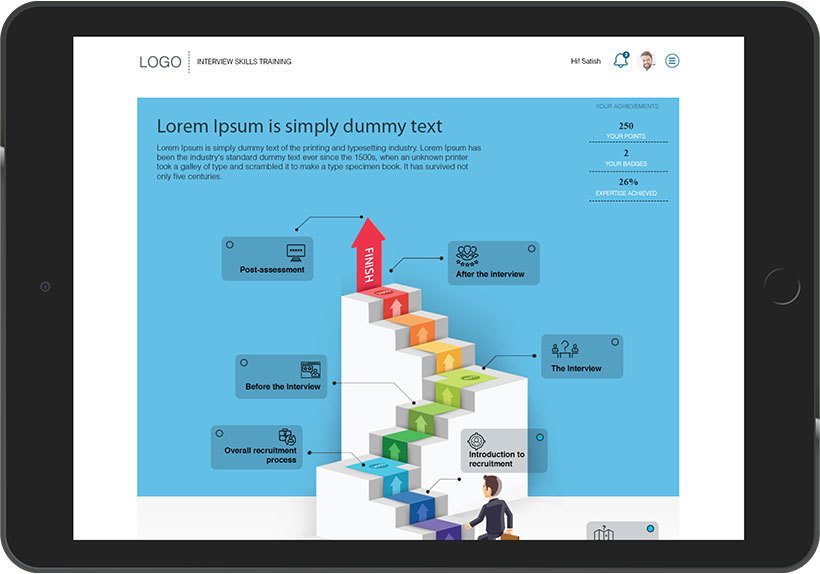
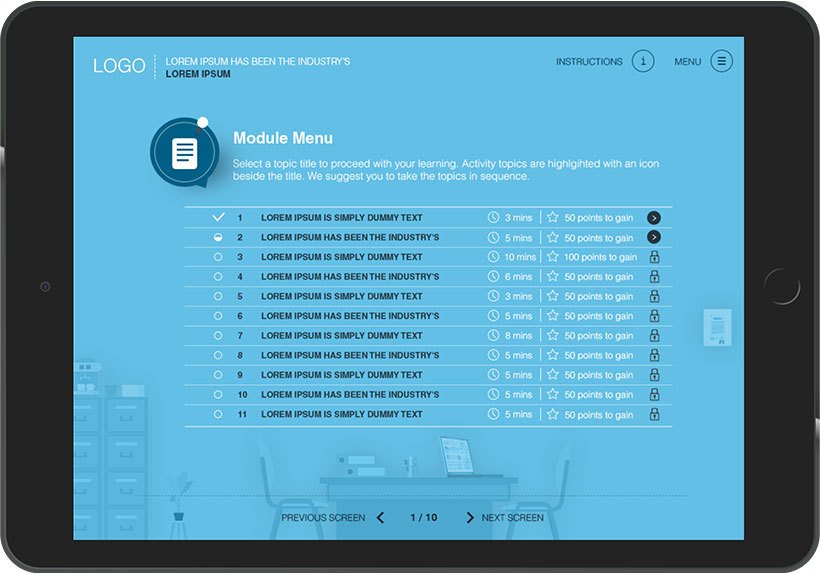
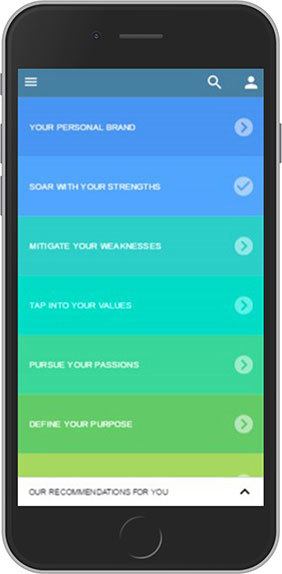
1.  Offer A Personalized And Gamified Learning Path
Microlearning nuggets can be woven into a highly relevant and personalized learning path. You can either gamify the learning path or have individual nuggets that feature gamification.
This example of gamified microlearning activities features:
  • A personalized learning path.
  • All microlearning topics have points associated with each of them.
  • A dashboard is accessible to the learners to view their progress through the topics and their performance in achieving points, badges, and expertise levels.
gamification-and-microlearning-techniques-img1gamification-and-microlearning-techniques-img2
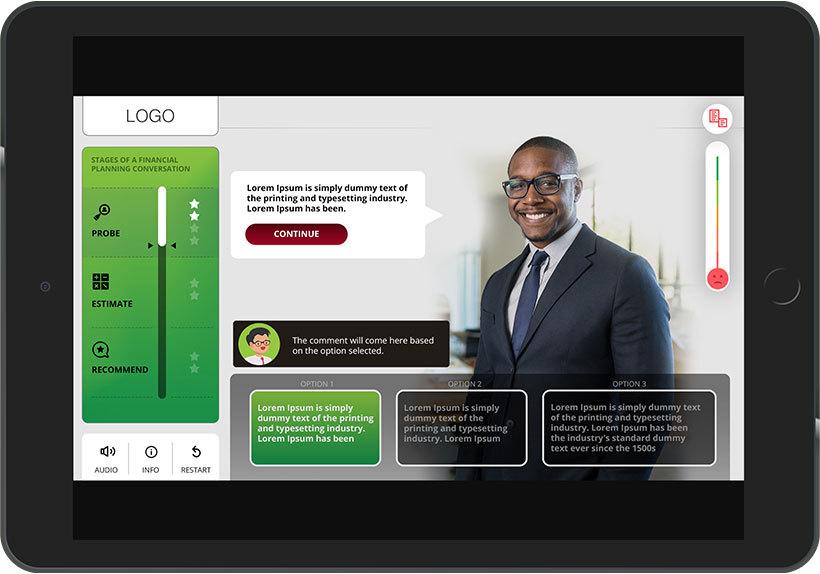
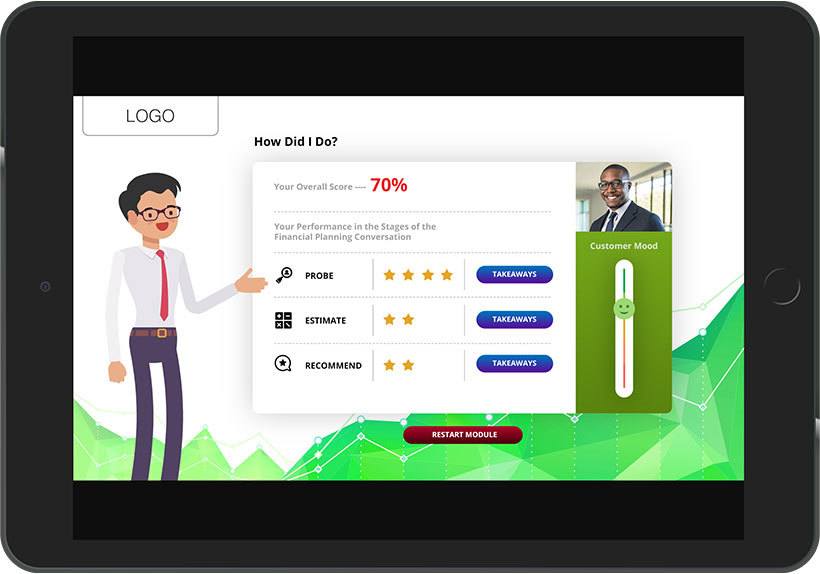
2.  Gamified Incentives To Enhance Performance
The gamified learning journey can offer a personalized performance indicator that can aid learners to focus on further improvement. You can nudge the learners to achieve this through gamification elements (points, badges, and recognition).
This example of gamified microlearning activities features:
  • An emotion meter and stars achieved at various stages of the gamified activity.
  • Through the performance indicator, the required cues are provided to learners on the improvement areas so that they can gain more points and achieve badges.
gamification-and-microlearning-techniques-img3gamification-and-microlearning-techniques-img4
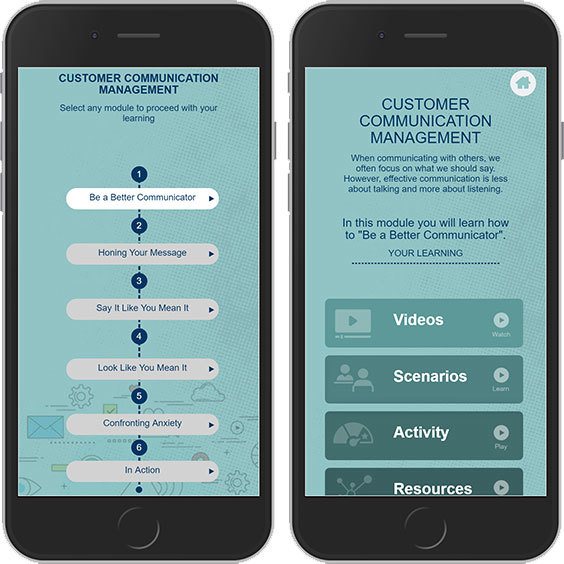
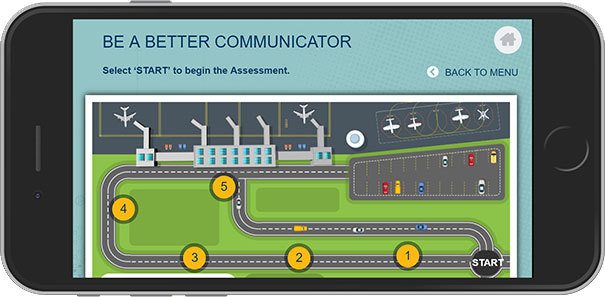
3.  Real-Time Feedback And Gamified Assets As Recommendations (Based On Learner Behavior) Can Help Learners Improve Their Performance
In this endeavor:
  • The remediation or reinforcement nuggets can be offered in a microlearning format that can be gamified.
  • The challenges can be offered as microlearning nuggets that have gamified scenarios and assessments.
  • The practice sessions to improve the skills can be gamified microlearning nuggets (can be offered in a stand-alone mode or connected through a gamified learning path).
This example of gamified microlearning activities features:
  • A microlearning based learning path consisting of various types of nuggets, including gamified practice activities and scenarios.
  • It also offers recommended learning nuggets based on learner performance/behavior.
gamification-and-microlearning-techniques-img5gamification-and-microlearning-techniques-img6gamification-and-microlearning-techniques-img7
4.  Curated Assets With Gamified Incentives
Besides offering the microlearning nuggets for formal training as well as job aids or learning aids, you can also offer curated assets. To encourage learners to go through them, you can use gamification elements such as points and badges.
This example of gamified microlearning activities features:
  • Curated assets that provide more information and deeper knowledge on the topics covered in the main learning path.
  • These too have points allocated to them for completion and adds to the overall points tally for the learner.
gamification-and-microlearning-techniques-img8
As you would have noted, the combination of microlearning and gamification in the format of gamified microlearning activities can be used in many ways to boost the impact of your corporate training.
In this article, I have touched upon a few facets of how you can leverage on this combination. In this endeavor, you are limited only by your imagination. If you have any queries or need any specific support, do contact me at apandey@eidesign.net.